
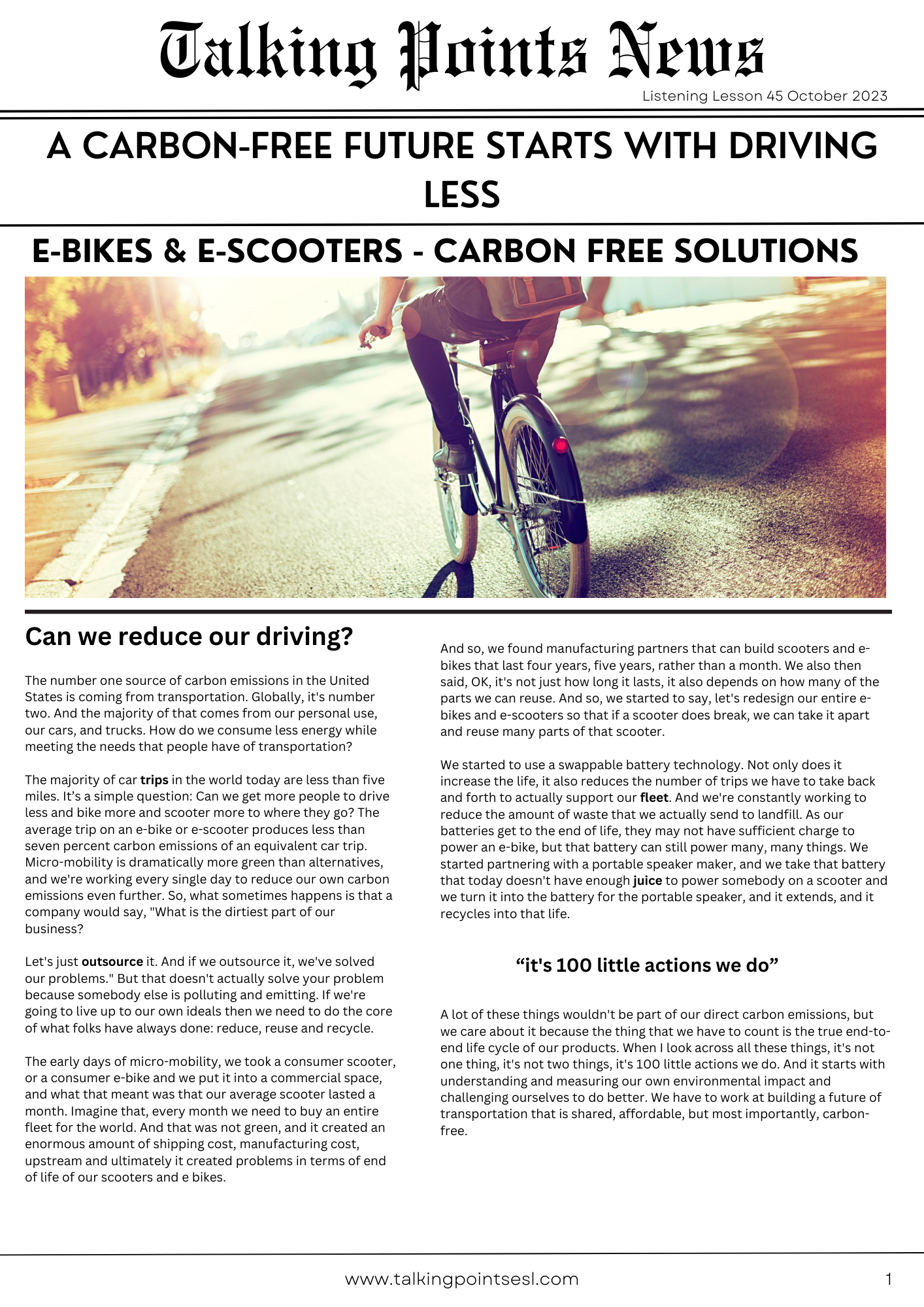


The number one source of carbon emissions in the United States is coming from transportation. Globally, it's number two. And the majority of that comes from our personal use, our cars, and trucks. How do we consume less energy while meeting the needs that people have of transportation? The majority of car trips in the world today are less than five miles. It’s a simple question: Can we get more people to drive less and bike more and scooter more to where they go? The average trip on an e-bike or e-scooter produces less than seven percent carbon emissions of an equivalent car trip. Micro-mobility is dramatically more green than alternatives, and we're working every single day to reduce our own carbon emissions even further. So, what sometimes happens is that a company would say, "What is the dirtiest part of our business? Let's just outsource it. And if we outsource it, we've solved our problems." But that doesn't actually solve your problem because somebody else is polluting and emitting. If we're going to live up to our own ideals then we need to do the core of what folks have always done: reduce, reuse and recycle. The early days of micro-mobility, we took a consumer scooter, or a consumer e-bike and we put it into a commercial space, and what that meant was that our average scooter lasted a month. Imagine that, every month we need to buy an entire fleet for the world. And that was not green, and it created an enormous amount of shipping cost, manufacturing cost, upstream and ultimately it created problems in terms of end of life of our scooters and e bikes.
And so, we found manufacturing partners that can build scooters and e-bikes that last four years, five years, rather than a month. We also then said, OK, it's not just how long it lasts, it also depends on how many of the parts we can reuse. And so, we started to say, let's redesign our entire e-bikes and e-scooters so that if a scooter does break, we can take it apart and reuse many parts of that scooter. We started to use a swappable battery technology. Not only does it increase the life, it also reduces the number of trips we have to take back and forth to actually support our fleet. And we're constantly working to reduce the amount of waste that we actually send to landfill. As our batteries get to the end of life, they may not have sufficient charge to power an e-bike, but that battery can still power many, many things. We started partnering with a portable speaker maker, and we take that battery that today doesn't have enough juice to power somebody on a scooter and we turn it into the battery for the portable speaker, and it extends, and it recycles into that life.
“it's 100 little actions we do”
A lot of these things wouldn't be part of our direct carbon emissions, but we care about it because the thing that we have to count is the true end-to-end life cycle of our products. When I look across all these things, it's not one thing, it's not two things, it's 100 little actions we do. And it starts with understanding and measuring our own environmental impact and challenging ourselves to do better. We have to work at building a future of transportation that is shared, affordable, but most importantly, carbon-free.
Questions:
Part 1: Comprehension
Watch and summarize the video thinking of who, what, when, where & why.
Part 2: True or False Questions
a) True or false – The biggest cause of carbon emissions in the US is the personal use of cars. T/F
b) True or False – The majority of car trips are less than 5 miles. T/F
c) True or False – Their batteries need to be disposed of correctly at the landfill site. T/F
d) True or False – The CEO likes to measure the company’s environmental impact. T/F
Part 3: Guess the meaning of unknown vocabulary
a) "Trips" (0:41 min)
b) "Outsource" (1:13 min)
c) "Fleet" (1:39 min)
d) "Juice" (2:43 min)
Part 4: Dictation
a) Fill in the blanks (0:15 - 0:23 minutes) And the ________________________________________________ trucks.
b) Fill in the blanks (2:24 - 2:36 minutes) And we're ______________________________________________ landfill.
c) Fill in the blanks (3:00 -3:12 minutes) When I look________________________________________________ we do.
Part 5: Talking Points
Part 6: Role play Scenarios
Scenario 1: Manager of a shared transportation company
You are the manager of a shared transportation company, and you want to convince your employees to switch from using gasoline-powered vehicles to electric ones. Roleplay a conversation with a skeptical employee who is worried about the cost and convenience of electric vehicles.
Scenario 2: Environmental activist
You are an environmental activist, and you want to organize a public demonstration to raise awareness about the impact of transportation on climate change. Roleplay a conversation with a group of volunteers who are eager to participate but have different ideas about the message and the tactics of the demonstration.
Scenario 3: Consumer
You are a consumer who wants to make more sustainable transportation choices but is overwhelmed by the options and the trade-offs. Roleplay a conversation with a friend who is knowledgeable about different modes of transportation and can provide you with practical advice and encouragement.
Part 7: Writing Activity
Describe the public transportation system in your city in as much detail as possible.
Part 8: Critical Thinking - Sustainable transportation.
Objective: Work collaboratively to design a sustainable transportation plan that reduces carbon emissions and promotes micro-mobility options for short trips in your local city.
Work in groups and create a presentation outlining a 5 point public transportation improvement plan that promotes the use of micro-mobility options in your city.
Present your plans and then as a class reach a consensus on the best overall plan.
Answers:
Part 1: Comprehension
This is a short Ted talk video posted on YouTube. The presenter is an entrepreneur called Wayne Ting and he is the CEO of a company called Lime. Lime seems to be a company that sells or rents electric scooters or bikes, and its CEO is talking about ways in which his company is trying to reduce carbon emissions. He first starts by saying that most car journeys are under 5 miles and if we can get people to use scooters it would dramatically reduce carbon emissions. Then Mr. Ting talks about how his company has designed its scooters so that they can be used for a long time and their parts can also be reused. Ultimately, Mr. Ting is proposing that we all must work at building a future of transportation that is shared, affordable, and carbon-free.
Part 2: True or False
A: False B: True C: False D: True
Part 3: Guess the meaning of unknown vocabulary or phrases
a) "Trips" Answer: This is the act of going to one place and then returning because in the video the speaker talks about how most journeys are under 5 miles and the distances that people travel when they go out.
b) "Outsource" Answer: To give the responsibility of a specific job to another company because in the video the CEO state that outsourcing the work would just be passing it on to someone else.
c) "Fleet" Answer: I think this is the total number of vehicles a company owns because in the video the speaker talks about changing all their vehicles on a monthly basis if they couldn’t reuse and recycle individual parts of the scooters.
d) "Juice"Answer: I think this means electrical power because the CEO talks about the batteries not being able to power scooters when they get old but proposes that they could power smaller devices.
Part 4: Dictation.
a) Fill in the blanks (0:15 - 0:23 minutes) And the majority of that comes from our personal use, our cars, and trucks.
b) Fill in the blanks (2:24 - 2:36 minutes) And we're constantly working to reduce the amount of waste that we actually send to landfill.
c) Fill in the blanks (3:00 -3:12 minutes) When I look across all these things, it's not one thing, it's not two things, it's 100 little actions we do.
Part 7: Writing (example)
In Tokyo, we have a big public transportation system. There are many trains, subways, and buses. The trains and subways are the most popular. They are very fast and come often. You don't have to wait long. The stations are clean and have signs in Japanese and English. You can use a card called 'Suica' or 'Pasmo' to pay. Just touch the card on a reader when you enter and leave the station. The trains connect different parts of the city and even go to other cities. They are usually on time. The buses are good too. They go to places where trains don't go. The bus stops have numbers and pictures to show where the bus goes. Tokyo's transportation is very busy, especially during morning and evening times. But it's a good way to travel in the city.


