
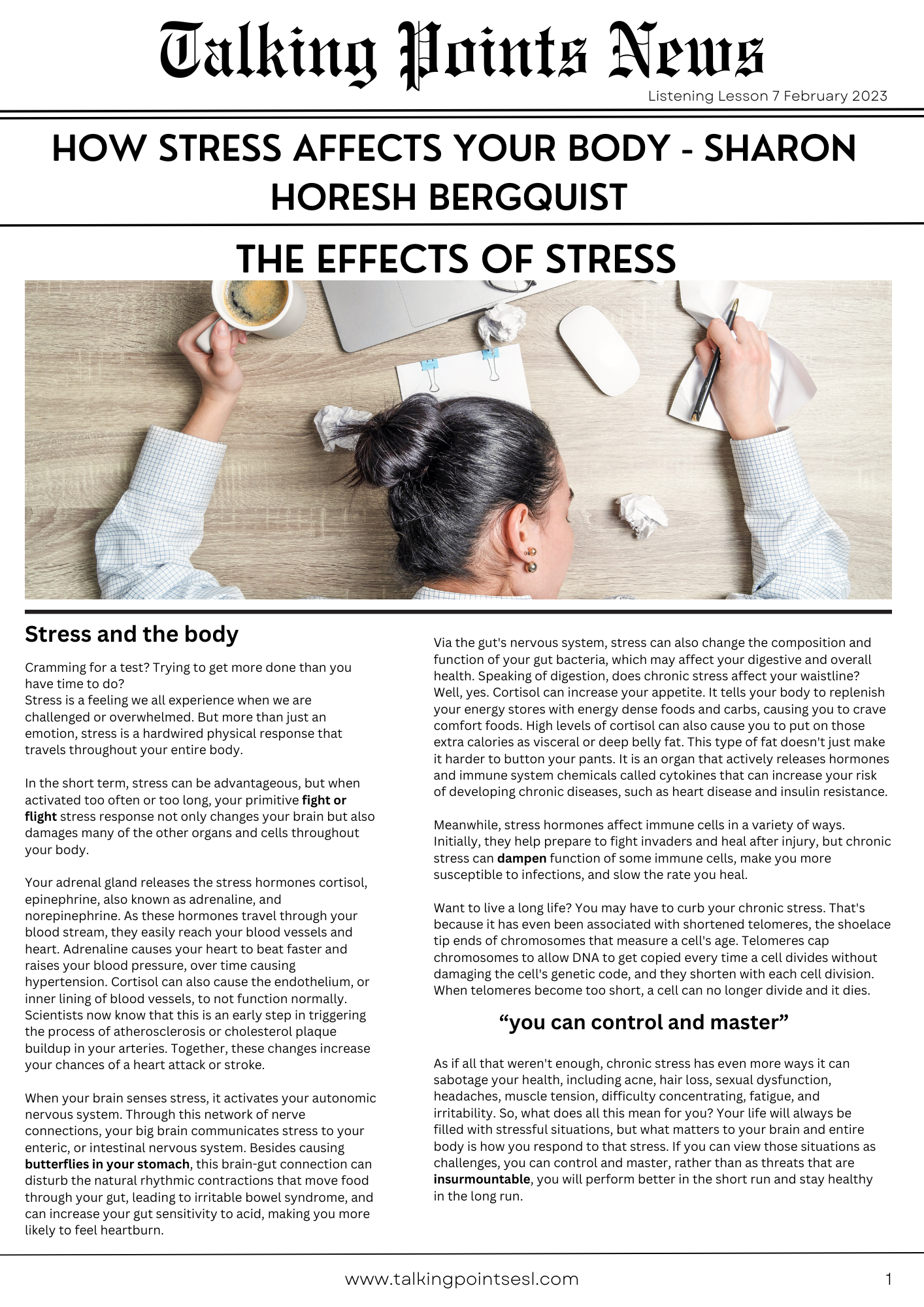


Cramming for a test? Trying to get more done than you have time to do?Stress is a feeling we all experience when we are challenged or overwhelmed. But more than just an emotion, stress is a hardwired physical response that travels throughout your entire body. In the short term, stress can be advantageous, but when activated too often or too long, your primitive fight or flight stress response not only changes your brain but also damages many of the other organs and cells throughout your body. Your adrenal gland releases the stress hormones cortisol, epinephrine, also known as adrenaline, and norepinephrine. As these hormones travel through your bloodstream, they easily reach your blood vessels and heart. Adrenaline causes your heart to beat faster and raises your blood pressure, over time causing hypertension. Cortisol can also cause the endothelium, or inner lining of blood vessels, to not function normally. Scientists now know that this is an early step in triggering the process of atherosclerosis or cholesterol plaque buildup in your arteries. Together, these changes increase your chances of a heart attack or stroke. When your brain senses stress, it activates your autonomic nervous system. Through this network of nerve connections, your big brain communicates stress to your enteric, or intestinal nervous system. Besides causing butterflies in your stomach, this brain-gut connection can disturb the natural rhythmic contractions that move food through your gut, leading to irritable bowel syndrome, and can increase your gut sensitivity to acid, making you more likely to feel heartburn.
Via the gut's nervous system, stress can also change the composition and function of your gut bacteria, which may affect your digestive and overall health. Speaking of digestion, does chronic stress affect your waistline? Well, yes. Cortisol can increase your appetite. It tells your body to replenish your energy stores with energy dense foods and carbs, causing you to crave comfort foods. High levels of cortisol can also cause you to put on those extra calories as visceral or deep belly fat. This type of fat doesn't just make it harder to button your pants. It is an organ that actively releases hormones and immune system chemicals called cytokines that can increase your risk of developing chronic diseases, such as heart disease and insulin resistance. Meanwhile, stress hormones affect immune cells in a variety of ways. Initially, they help prepare to fight invaders and heal after injury, but chronic stress can dampen function of some immune cells, make you more susceptible to infections, and slow the rate you heal. Want to live a long life? You may have to curb your chronic stress. That's because it has even been associated with shortened telomeres, the shoelace tip ends of chromosomes that measure a cell's age. Telomeres cap chromosomes to allow DNA to get copied every time a cell divides without damaging the cell's genetic code, and they shorten with each cell division. When telomeres become too short, a cell can no longer divide and it dies.
“you can control and master”
As if all that weren't enough, chronic stress has even more ways it can sabotage your health, including acne, hair loss, sexual dysfunction, headaches, muscle tension, difficulty concentrating, fatigue, and irritability. So, what does all this mean for you? Your life will always be filled with stressful situations, but what matters to your brain and entire body is how you respond to that stress. If you can view those situations as challenges, you can control and master, rather than as threats that are insurmountable, you will perform better in the short run and stay healthy in the long run.
Part 1: Comprehension
Watch and summarize the video thinking of who, what, when, where & why.
Part 2: True or False Questions
a) True or false – Stress can be advantageous. T/F
b) True or False – Adrenaline causes your heart to beat faster. T/F
c) True or False – It’s not possible to control and master stressful situations. T/F
d) True or False – Chronic stress can slow the rate we heal. T/F
Part 3: Guess the meaning of unknown vocabulary
a) "Fight or flight" (0:35 min)
b) "Butterflies in your stomach" (1:47 min)
c) “Dampen" (3:06 min)
d) "Insurmountable" (4:18 min)
Part 4: Dictation
a) Fill in the blanks (0:13 - 0:20 minutes) Stress _______________________________________________________overwhelmed.
b) Fill in the blanks (0:54 - 1:01 minutes) As ____________________________________________________________heart.
c) Fill in the blanks (4:04 - 4:13 minutes) Your life ______________________________________________________stress.
Part 5: Talking Points
Part 6: Role play Scenarios
Scenario 1: Doctor-Patient
One student plays the role of a patient visiting a doctor's office for stress-related symptoms, while the other student plays the role of the doctor. The patient can describe their symptoms, and the doctor can ask questions to diagnose the problem and suggest treatment options.
Scenario 2: Job Interview
One student plays the role of a job candidate, while the other student plays the role of the interviewer. The interviewer can ask questions about how the candidate handles stress, and the candidate can give examples of past experiences and strategies for coping with stress.
Scenario 3: Manager-Employee
One student plays the role of an employee dealing with work-related stress, while the other student plays the role of the manager. The employee can describe their stressors, and the manager can offer solutions for reducing stress and improving work-life balance.
Part 7: Writing Activity
Imagine that your best friend came to you for advice on how to manage stress. What would you advise them?
Part 8: Critical Thinking - Should there be sports in schools?
Objective: Create a company or school stress management policy.
In groups create a presentation that outlines a stress management strategy in your school or company.
Consider things such as: Current policy, sick leave, facilities, counciling, overtime, stress at work, work-life balance.
Present your policy to the class then reach a consensus on the best one.
Answers:
Part 1: Comprehension
This video was created by TedEd an educational source created to give educators and professionals a platform to promote their ideas and share their knowledge and opinions. In this video, the speaker talks about stress and how it affects our bodies. He proposes that it is more than just an emotion but rather a hardwired physical response that travels through our entire body. The video describes the impact that stress has on our bodies and states that some stress can have a positive impact on us, but prolonged stress can cause illnesses ranging from headaches and difficulty concentrating to blocked arteries and heart attacks. The speaker also notes the potential link between stress, our stomach, and our brains and proposes that stress can make us crave unhealthy foods which would further impact our overall health. I think this video was made to raise awareness of the dangers of stress and encourage listeners to seek ways to relieve their stress.
Part 2: True or False
A: True B: True C: False D: True
Part 3: Guess the meaning of unknown vocabulary or phrases
a) "Fight or flight" Answer: I think fight or flight is a physiological response to a threatening/challenging situation because in the listening the speaker talks about how our bodies react to stressful situations. As the listening says it is our primitive reaction to a treating situation, I can guess that it means to stay and fight or get out of the situation quickly.
b) "Butterflies in your stomach" Answer: I think butterflies in our stomach means to feel a nervous or anxious feeling in our stomach because in the video the speaker talks about the impact that stress has on our stomach and how it makes us feel anxious.
c) "Dampen" Answer: I think to dampen something means to weaken something or make it less effective in this situation because the speaker talks about the ways that stress hormones affect immune cells and he is emphasizing the fact that chronic stress can cause lasting damage thus reducing the efficiency of immune cells.
d) "Insurmountable" Answer: I think insurmountable means too great to overcome because in the listening the speaker talks about making problems or difficult situations easier to manage so that they don’t become stressful or so big that we cannot control them.
Part 4: Dictation
a) Fill in the blanks (0:08 - 0:28 minutes) Stress is a feeling we all experience when we are challenged or overwhelmed.
b) Fill in the blanks (0:46 - 1:09 minutes) As these hormones travel through your bloodstream, they easily reach your blood vessels and heart.
c) Fill in the blanks (4:01 - 4:25 minutes) Your life will always be filled with stressful situations, but what matters to your brain and entire body is how you respond to that stress.
Part 7: Writing (example)
If my best friend, Jae Min, who's an engineer at a big company, asked me for advice on handling stress, I would tell him to take care of himself by doing things he enjoys, like hobbies or relaxation exercises. It's also important to manage time wisely, set realistic goals, and make a to-do list. Jae Min should aim for a good balance between work and personal life, which means setting boundaries and not working too much overtime. Eating well, exercising regularly, and getting enough sleep are essential for reducing stress. If he ever feels overwhelmed, I'd advise him to talk to friends, family, or even a professional for support. Mindfulness and relaxation techniques like yoga or short breaks during the day can also help. Plus, it's okay not to be perfect, and Jae Min should try to focus on the positive things in his life and work. Stress can be challenging, but with the right strategies and support, it can be managed.


