
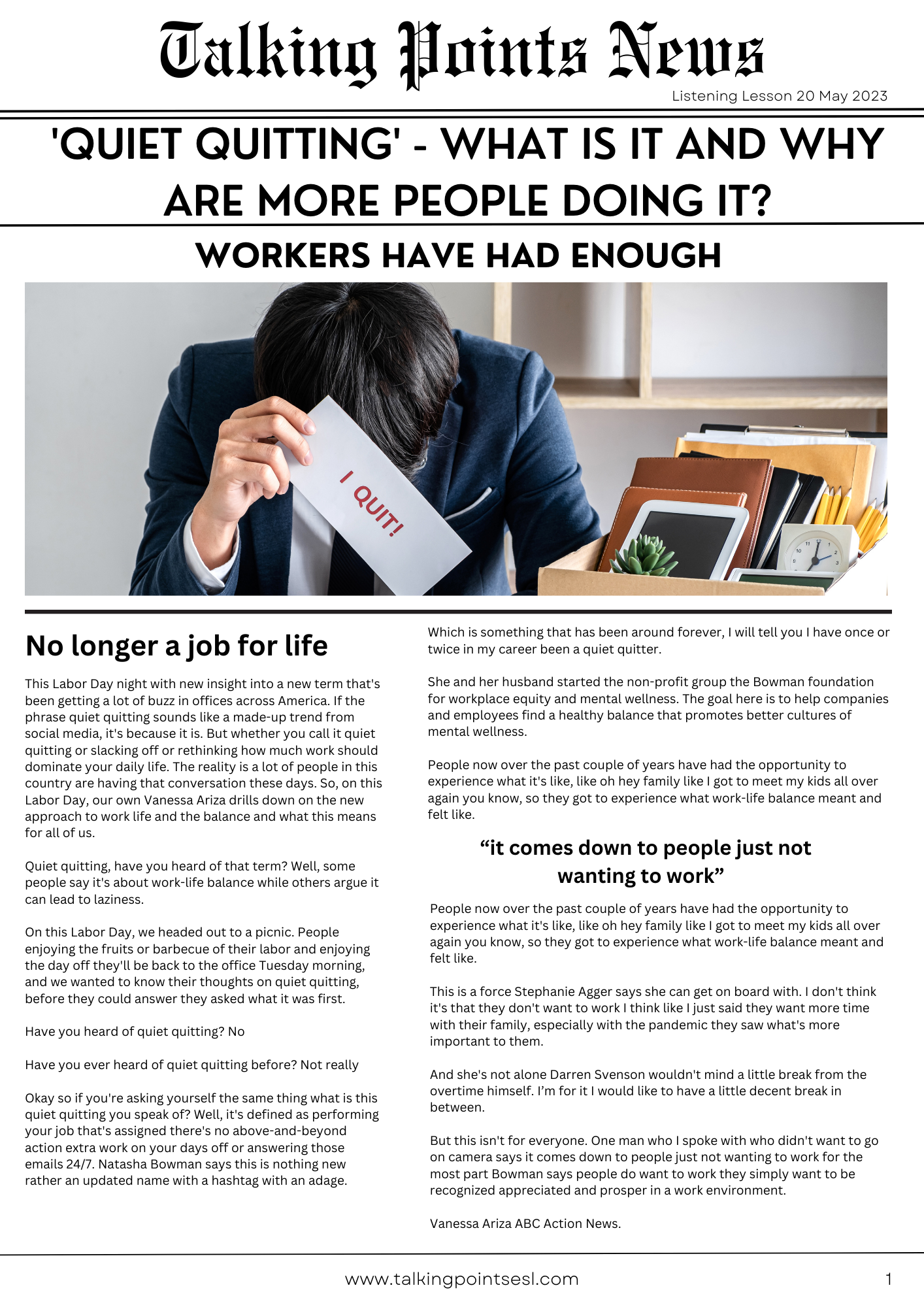

Workers have had enough.
No longer a job for life.
Script:
This Labor Day night with new insight into a new term that's been getting a lot of buzz in offices across America. If the phrase quiet quitting sounds like a made-up trend from social media, it's because it is. But whether you call it quiet quitting or slacking off or rethinking how much work should dominate your daily life. The reality is a lot of people in this country are having that conversation these days. So, on this Labor Day, our own Vanessa Ariza drills down on the new approach to work life and the balance and what this means for all of us.Quiet quitting, have you heard of that term? Well, some people say it's about work-life balance while others argue it can lead to laziness. On this Labor Day, we headed out to a picnic. People enjoying the fruits or barbecue of their labor and enjoying the day off they'll be back to the office Tuesday morning, and we wanted to know their thoughts on quiet quitting, before they could answer they asked what it was first. Have you heard of quiet quitting? No Have you ever heard of quiet quitting before? Not really Okay so if you're asking yourself the same thing what is this quiet quitting you speak of? Well, it's defined as performing your job that's assigned there's no above-and-beyond action extra work on your days off or answering those emails 24/7. Natasha Bowman says this is nothing new rather an updated name with a hashtag with an adage.
Which is something that has been around forever, I will tell you I have once or twice in my career been a quiet quitter.She and her husband started the non-profit group the Bowman foundation for workplace equity and mental wellness. The goal here is to help companies and employees find a healthy balance that promotes better cultures of mental wellness. People now over the past couple of years have had the opportunity to experience what it's like, like oh hey family like I got to meet my kids all over again you know, so they got to experience what work-life balance meant and felt like.
“it comes down to people just not wanting to work”
People now over the past couple of years have had the opportunity to experience what it's like, like oh hey family like I got to meet my kids all over again you know, so they got to experience what work-life balance meant and felt like. This is a force Stephanie Agger says she can get on board with. I don't think it's that they don't want to work I think like I just said they want more time with their family, especially with the pandemic they saw what's more important to them. And she's not alone Darren Svenson wouldn't mind a little break from the overtime himself. I’m for it I would like to have a little decent break in between. But this isn't for everyone. One man who I spoke with who didn't want to go on camera says it comes down to people just not wanting to work for the most part Bowman says people do want to work they simply want to be recognized appreciated and prosper in a work environment. Vanessa Ariza ABC Action News.
Questions:
Part 1: Comprehension
Watch and summarize the video thinking of who, what, when, where & why.
Part 2: True or False Questions
a) True or false – Offices throughout America are buzzing because it’s Labor Day. T/F
b) True or False – Some people think that quiet quitting can lead to laziness. T/F
c) True or False – quiet quitters don’t go above and beyond their set work tasks. T/F
d) True or False – The Bowman Foundation promotes quiet quitting. T/F
Part 3: Guess the meaning of unknown vocabulary.
a) "Buzz" (0:04 min)
b) "Slacking off" (0:13 min)
c) "Work-life balance" (0:37 min)
d) "Prosper" (2:39 min)
Part 4: Dictation
a) Fill in the blanks (0:43 - 0:47 minutes) On __________________________________________________________picnic.
b) Fill in the blanks (1:10 - 1:24 minutes) Well, _________________________________________________________ emails 24/7.
c) Fill in the blanks (1:40- 1:49 minutes) The goal here _________________________________________________wellness.
Part 5: Talking Points
Part 6: Role play Scenarios
Scenario 1: Employee and Supervisor
You are an employee who has been consistently working overtime and answering work-related emails on your days off. You feel overwhelmed and stressed, and you want to have a conversation with your supervisor about achieving a better work-life balance.
Scenario 2: Colleague to Colleague
You are a colleague who has noticed that one of your team members has been consistently working late and answering work-related emails outside of regular working hours. You want to have a conversation with them about the importance of maintaining a healthy work-life balance.
Scenario 3: Manager and Team Member
You are a manager who has noticed that one of your team members has been consistently working long hours and showing signs of burnout. You want to have a conversation with them about the importance of maintaining a healthy work-life balance.
Part 7: Writing Activity
Write a short paragraph outlining your future career goals, and describing what job or position to do in the future.
Part 8: Critical Thinking - How to prevent quiet quitting
Objective: Come up with a 5 point strategy that would stop people from quiet quitting in their jobs.
In groups come up with a 5 point plan, and present it to the class.
Then reach a consensus on the best 5 point strategy to prevent quiet quitting.
Answers:
Part 1: Comprehension
This video was created by ABC Action News company in America, and it looks at the new trend of “quiet quitting”. ABC Action News reports that the latest made-up trend on social is a term called quiet quitting. The reporter states that some people think this term refers to unhappy employees who are lazy and simply do the bare minimum in their job, while others think that it simply relates to having a good work-life balance. The reporter interviews some people to get their views on quiet quitting, and more specifically talks with Natasha Bowman who founded the Bowman Foundation for workplace equity and mental wellness. She said that quiet quitting is nothing new and that people both value and need to spend more time with their families.
Part 2: True or False
A: False B: True C: True D: False
Part 3: Guess the meaning of unknown vocabulary or phrases
a) "Buzz" Answer: I think this means an atmosphere of excitement or activity because in the video the report talks about how quiet quitting is being talked about in offices all over the country and how it’s the latest trend.
b) "Slacking off" Answer: I think slacking off means doing something with less effort or energy than before because in the report they talk about how employees are just doing the minimum required work and are no longer going above and beyond their job specifications.
c) "Work-life balance" Answer: I think this simply means to strike a good balance between your personal life and working life because in the video they talk about quiet quitting giving people the chance to complete their work but also spend more time with their families.
d) "Prosper" Answer: This means to be successful in the jobs because in the video the speaker says that even though to do the minimum, they want to do their tasks well, they want to gain recognition, and be more successful in their job.
Part 4: Dictation
a) Fill in the blanks (0:43 - 0:47 minutes) On this Labor Day, we headed out to a picnic.
b) Fill in the blanks (1:10 - 1:24 minutes) Well, it's defined as performing your job that's assigned there's no above-and-beyond action extra work on your days off or answering those emails 24/7.
c) Fill in the blanks (1:40 - 1:49 minutes) The goal here is to help companies and employees find a healthy balance that promotes better cultures of mental wellness.
Part 7: Writing (example)
As a 27-year-old civil engineer, my career goals are firmly rooted in both advancement and impact. In the near future, I aspire to become a project manager, overseeing large-scale infrastructure projects. This role would allow me to apply my technical skills and creativity to solve complex engineering challenges, while also developing my leadership and management abilities. Long-term, I aim to contribute to sustainable and innovative urban development projects, potentially leading a team dedicated to eco-friendly and smart city solutions. My ultimate goal is to play a pivotal role in shaping more resilient and efficient urban environments, leveraging my expertise in civil engineering to make a significant and positive impact on communities and the environment."


