
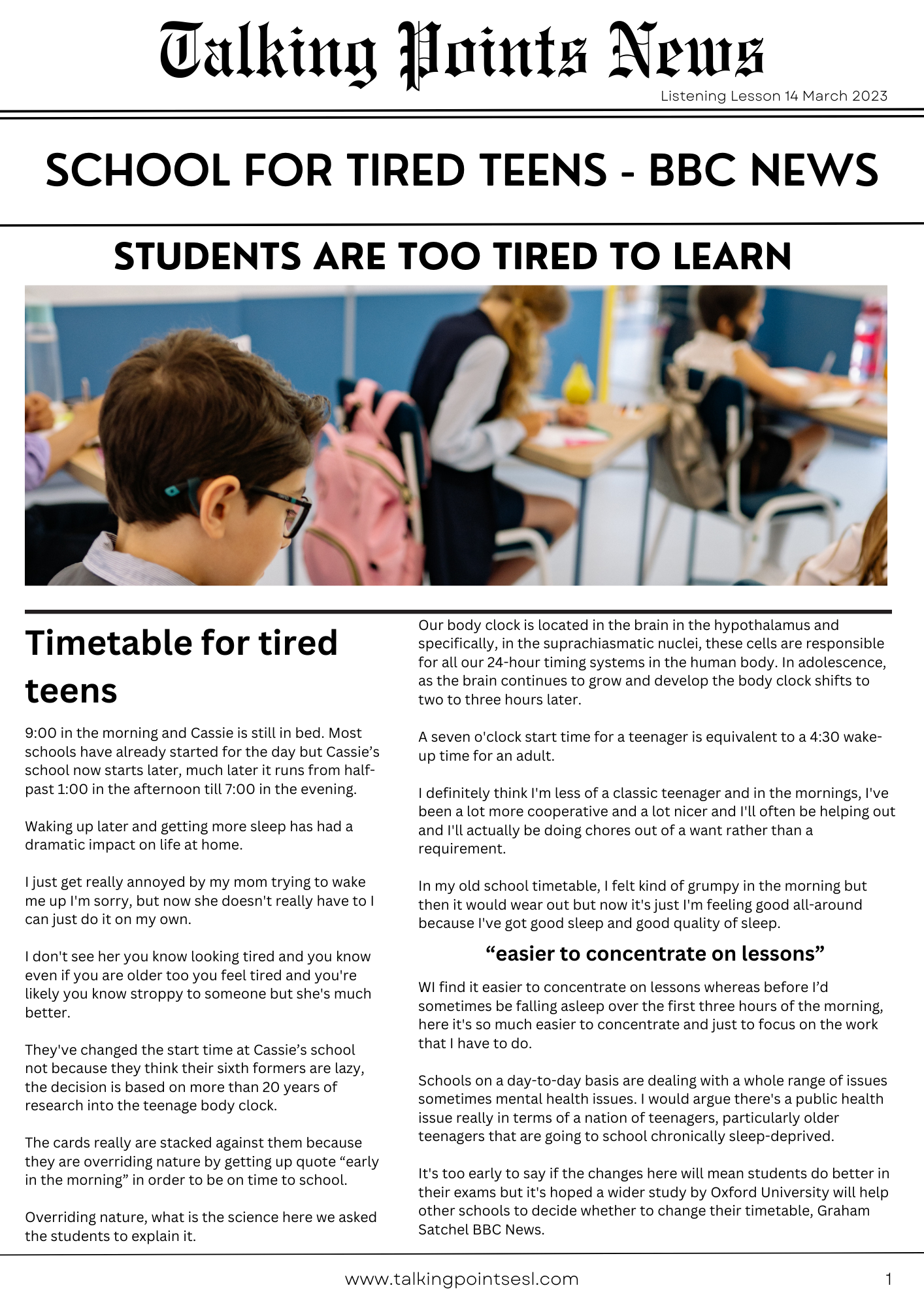

9:00 in the morning and Cassie is still in bed. Most schools have already started for the day but Cassie’s school now starts later, much later it runs from half-past 1:00 in the afternoon till 7:00 in the evening.Waking up later and getting more sleep has had a dramatic impact on life at home. I just get really annoyed by my mom trying to wake me up I'm sorry, but now she doesn't really have to I can just do it on my own. I don't see her you know looking tired and you know even if you are older too you feel tired and you're likely you know stroppy to someone but she's much better. They've changed the start time at Cassie’s school not because they think their sixth formers are lazy, the decision is based on more than 20 years of research into the teenage body clock. The cards really are stacked against them because they are overriding nature by getting up quote “early in the morning” in order to be on time to school. Overriding nature, what is the science here we asked the students to explain it.
Our body clock is located in the brain in the hypothalamus and specifically, in the suprachiasmatic nuclei, these cells are responsible for all our 24-hour timing systems in the human body. In adolescence, as the brain continues to grow and develop the body clock shifts to two to three hours later. A seven o'clock start time for a teenager is equivalent to a 4:30 wake-up time for an adult.I definitely think I'm less of a classic teenager and in the mornings, I've been a lot more cooperative and a lot nicer and I'll often be helping out and I'll actually be doing chores out of a want rather than a requirement. In my old school timetable, I felt kind of grumpy in the morning but then it would wear out but now it's just I'm feeling good all-around because I've got good sleep and good quality of sleep.
“easier to concentrate on lessons”
WI find it easier to concentrate on lessons whereas before I’d sometimes be falling asleep over the first three hours of the morning, here it's so much easier to concentrate and just to focus on the work that I have to do.Schools on a day-to-day basis are dealing with a whole range of issues sometimes mental health issues. I would argue there's a public health issue really in terms of a nation of teenagers, particularly older teenagers that are going to school chronically sleep-deprived. It's too early to say if the changes here will mean students do better in their exams but it's hoped a wider study by Oxford University will help other schools to decide whether to change their timetable, Graham Satchel BBC News.
Questions:
Part 1: Comprehension
Watch and summarize the video thinking of who, what, when, where & why.
Part 2: True or False Questions
a) True or false – Cassie gets up at 1:30 pm. T/F
b) True or False – sixth form students are lazy when they start classes at 9 am. T/F
c) True or False – Students felt grumpy all day on the old timetable. T/F
d) True or False – Oxford University will conduct further studies on this matter. T/F
Part 3: Guess the meaning of unknown vocabulary.
a) "Stroppy" (0:38 min)
b) "Cards really are stacked against them" (0:50 min)
c) "Day-to-day basis" (2:11 min)
d) "Sleep-deprived" (2:26 min)
Part 4: Dictation
a) Fill in the blanks (0:01 - 0:12 minutes) Most ____________________________________________________________evening.
b) Fill in the blanks (1:20 - 1:46 minutes) And in ___________________________________________________________requirement.
c) Fill in the blanks (1:57 - 2:10 minutes) I find _____________________________________________________________the morning,
Part 5: Talking Points
Part 6: Role play Scenarios
Scenario 1: School Board Meeting
You're on the school board, discussing whether to adjust school start times to fit teenagers' sleep patterns. Some members support the change due to its benefits for students' health, while others worry about logistics and pushback from the community. Engage with board members, administrators, parents, and students to weigh the advantages and challenges, and consider solutions.
Scenario 2: Parent-Teacher Conference
You're a concerned parent noticing changes in your teenager's behavior and school performance. The teacher suggests that early start times could be causing sleep deprivation, impacting mood and focus. In a conversation with the teacher, you'll express your worries and talk about potential solutions like pushing for later school starts, changing bedtime habits, or improving sleep practices.
Scenario 3: Teenager's Morning Routine
You're a teen struggling with early school mornings and daytime fatigue. Roleplay with your parent trying to wake you up, share your frustrations, and discuss how early school affects you. Talk about better sleep strategies like a regular bedtime and a calming nighttime routine.
Part 7: Writing Activity
Describe your high school experience. What did you do in school? what did you like to study? what games did you play? what food did you eat?
Part 8: Critical Thinking - Late starts for everyone
Objective: To engage in a group discussion and reach a consensus on whether school start times should be adjusted to better accommodate teenagers' sleep needs (in your country).
Work in groups and discuss the advantages and disadvantages of later start times for teenagers in school. Then, come back and reach a consensus on the topic.
Team A supports the idea while Team B opposes it.
Answers:
Part 1: Comprehension
This is a news report created by Graham Satchel from the BBC. He is reporting on a unique schedule that 6th-form students have in a school in the UK. The students at this school start school at 1:30 pm and finish at 7 pm. This school starts later to allow their pupils to get a good night’s sleep and this helps the concentrate more on their studies. The reporter interviews some students and a teacher. The students believe that the schedule is great, it enables them to get better sleep, which means they are more focused and less grumpy. Researchers say that during adolescence our body clock shifts to a few hours later allowing the brain to develop and grow more. This means that the new later schedule helps students’ study at the times when their brain is most active. I think the report wants to highlight that there are new more modern approaches to school schedules
Part 2: True or False
A: False B: False C: False D: True
Part 3: Guess the meaning of unknown vocabulary or phrases.
a) "Stroppy" Answer: I think stroppy means bad-tempered or argumentative because in the video the student is talking about how she felt when waking up early and said that she felt tired and grumpy and always got annoyed with her mom.
b) "Cards really are stacked against them" Answer: I think it means not having a fair chance at something. In the video, the teacher is talking about the development of adolescent brains and how they work on a different body clock. This means if they start school early in the morning it makes learning more difficult.
c) "Day-to-day basis" Answer: It means things that happen regularly or everyday occurrence because in the video the speaker talks about the latest issues that schools have to deal with every day.
d) "Sleep-deprived" Answer: I think sleep-deprived means suffering from a lack of sleep because in the video this term is used when talking about adolescents who are not getting enough sleep.
Part 4: Dictation
a) Fill in the blanks (0:01 - 0:24 minutes) Most schools have already started for the day but Cassie’s school now starts later, much later it runs from half-past 1:00 in the afternoon till 7:00 in the evening.
b) Fill in the blanks (1:05 - 1:47 minutes) And in the mornings, I've been a lot more cooperative and a lot nicer and I'll often be helping out and I'll actually be doing chores out of a want rather than a requirement.
c) Fill in the blanks (2:36 - 3:14 minutes) I find it easier to concentrate on lessons whereas before I’d sometimes be falling asleep over the first three hours of the morning,
Part 7: Writing (example)
High school in Korea was very busy with a lot of studying. I wore a uniform and carried many books. I studied subjects like Korean, English, and Math, but English was my favorite because it was interesting. In the school cafeteria, I ate Korean food like kimchi and rice. After school, I went to hagwon for more lessons. Sometimes I played games like Baduk or computer games at the PC bang. I also played soccer and basketball for exercise. Even though I studied a lot, I had fun at school festivals where I danced and played music. High school was hard, but I made good friends and we worked together for our future.


