I was born in the late 70s, in my lifetime we've seen rates of obesity skyrocket, do we know what's happened to the kind of food we eat as a nation? We have some very good data from the 1980s up until 2000 looking at the changes in household spending on food. How we spend our money and what we spend it on.Exactly! This represents not just fruit and veg but all the spending of a household in 1980 on ingredients. So, this would also be oil, salt, sugar, meat?That's exactly right. So how much were people spending on convenience-ready foods? So, the studies show that 58% of household expenditure on food in 1980 was essentially spent on ingredients, fresh ingredients to make home-cooked meals as opposed to 26% of households spending on food which was spent on convenience food. But look what happened next, over the following 20 years our spending on fresh ingredients shrank to just 28 percent. Whilst our spending on convenience foods almost doubled to 44 percent. When you lay it out like this it's a spectacular transformation. This goes from being the majority of our diet to that entirely different category of food being the majority of our diet.Absolutely. What's happening to obesity over this period? It’s a shocking change we see that in 1980 around seven percent of adults in the UK were obese this shot up in the year 2000 to about 20 percent, so a tripling of obesity rates over the same time we see this transition in our diet.
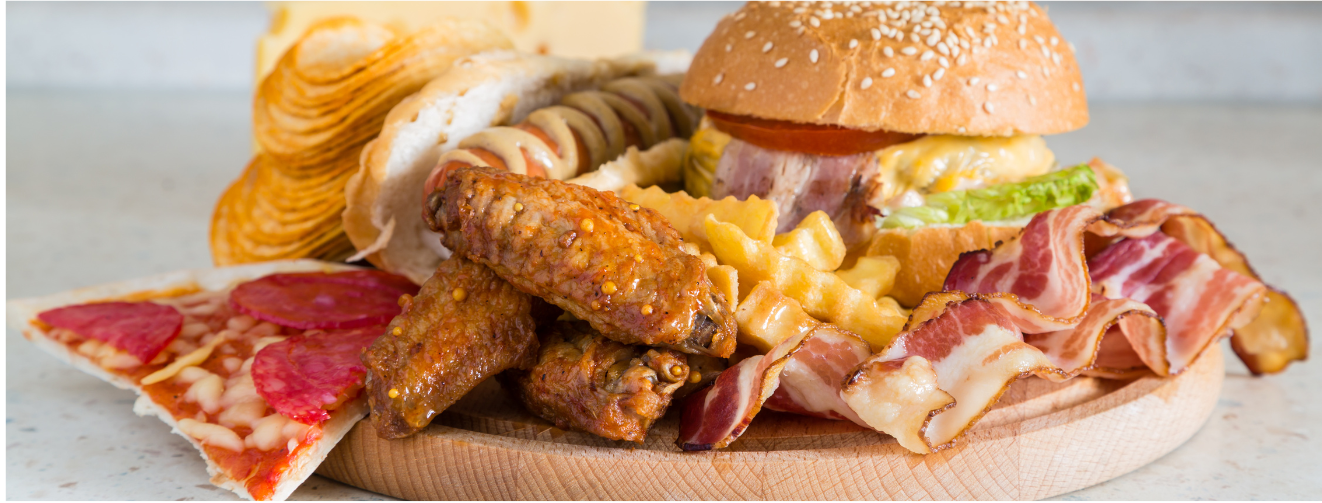
But has this trend continued? Fast forwarding to what we're eating now, this circle represents our current diet. Chris, that's a lot of ultra-processed food.57 percent of calories consumed amongst the whole UK population is from ultra-processed food. The shocking thing is actually the number is much higher amongst our young people, amongst children is 64 percent and amongst adolescents, it's 68 percent. And there are some people in the UK who are eating a huge proportion of ultra-processed food.One in five people in the UK population have 80 percent of their diets coming from ultra-processed foods in terms of calories. What are the implications for human health?We know from data which is comparing different countries and also following up with people over time that ultra-processed foods are a major contributor to this increase in obesity that we're seeing in the country.
“its diet which is driving the growth and obesity”
What about falling rates of activity and exercise? It is an important factor but the overwhelming scientific evidence suggests that its diet which is driving the growth and obesity that we've seen. And yet most of us have never even heard of the ultra-processed food, of UPF.I mean that's true, and part of the reason is that it's a new concept. What we can say is the scientific evidence is growing really rapidly showing the harm of these products. Not everyone agrees because while they're strongly linked, major food manufacturers and some scientists don't yet believe there's proof that ultra-processed foods directly cause obesity but lots of people are convinced.There's a growing consensus amongst the scientific community that this is a valid and robust approach. To think about how what we eat influences our health and organizations such as the world health organization are taking this concept seriously.
Questions:
Part 1: Comprehension
Watch and summarize the video thinking of who, what, when, where & why.
Part 2: True or False Questions
a) True or false – Obesity skyrocketed in the 1970s when the doctor was born. T/F
b) True or False – 58% of household expenditure on food in 1980 was essentially spent on ingredients and fresh ingredients. T/F
c) True or False – Falling rates of activity and exercise play a bigger role in the increasing levels of obesity. /F
d) True or False – Some major food manufacturers and scientists don't yet believe there's proof that ultra-processed foods directly cause obesity. T/F
Part 3: Guess the meaning of unknown vocabulary.
a) "Skyrocket" (0:05 min)
b) "Convenience-ready foods" (0:41 min)
c) "Shrank" (1:09 min)
d) "Adolescents" (2:18 min)
Part 4: Dictation
a) Fill in the blanks (0:45 - 1:03 minutes) So, the studies show that 58% of ______________________________________________ food.
b) Fill in the blanks (1:31 - 1:49 minutes) It’s a shocking change ___________________________________________________________ this transition in our diet.
c) Fill in the blanks (3:41 - 3:50 minutes) To think __________________________________________________________________________ seriously.
Part 5: Talking Points
Part 6: Role play Scenarios
Scenario 1: Grocery Store Visit
In this scenario, one person plays the role of a health-conscious consumer who is trying to make healthier food choices, and the other person plays the role of a grocery store clerk. The consumer asks the clerk for recommendations on fresh ingredients to cook a homemade meal.
Scenario 2: School Cafeteria Discussion
In this scenario, one person plays the role of a concerned parent who is advocating for healthier food options in their child's school cafeteria, and the other person plays the role of a school administrator.
Scenario 3: Family Dinner Conversation
In this scenario, family members gather for a dinner at home, and engage in a conversation about the impact of ultra-processed foods on health. One person plays the role of a family member who is knowledgeable about the topic, and shares information from the article about the link between ultra-processed foods and obesity.
Part 7: Writing Activity
Give some advice to a friend making recommendations on how they can maintain a healthy diet.
Part 8: Critical Thinking - Stay Healthy Campaign.
Objective: To create a stay healthy campaign for your company/school.
Work in groups and create a presentation that promotes a healthy lifestyle in your work or school.
Introduce ways that employees/students can maintain a healthy work-life balance, improve their diets and ways the the company/school can and will support them.
Hold a Q&A session after each presentation and reach a consensus on the best ways to promote healthy living in your work or school.
Answers:
Part 1: Comprehension
This video was created by the BBC, and it reports on the changing eating habits of the people living in the UK. The reporter interviews Dr. Chris Van Tulleken and discusses the changes in eating habits and the negative impact that they are having on society. The report looks at data collected on household food spending habits from the 1980s right up to the 2000s. It was discovered that in 1980 58% of households spent money on fresh foods with just 26% being spent on convenience foods. However, 20 years later spending on convenience food doubled and people spend just 26% on fresh ingredients. Dr. Chris Van Tulleken also states that these changes coincide with the obesity figures as they have tripled over the last 20 years. The video also discusses how 1 in 5 people are now living on ultra-processed foods which are terrible for our health. Lastly, the doctor talks about the different health implications that this is having on society.
Part 2: True or False
A: False B: True C: False D: True
Part 3: Guess the meaning of unknown vocabulary or phrases
a) "Skyrocket" Answer: I think that this means to increase rapidly because in the video the doctor talks about how obesity has more than tripled since the 1970s. Therefore, obesity levels have increased rapidly.
) "Convenience-ready foods" Answer: I think this means food that can be cooked easily like in a microwave, but it is usually unhealthy because the video talks about how these types of food are increasing at the same rate as obesity.
c) "Shrank" Answer: This is the past tense of the verb to shrink, and it means to get smaller because in the video the speaker talks about how households throughout the UK are reducing their spending on fresh food such as fruit and vegetables.
d) "Adolescents" Answer: I think this means a young person in the process of developing into an adult because in the video the doctor talks about how the obesity crisis is affecting the younger generation the most.
Part 4: Dictation
a) Fill in the blanks (0:45 - 1:03 minutes) So, the studies show that 58% of household expenditure on food in 1980 was essentially spent on ingredients, fresh ingredients to make home-cooked meals as opposed to 26% of households spending on food which was spent on convenience food.
b) Fill in the blanks (1:31 - 1:49 minutes) It’s a shocking change we see that in 1980 around seven percent of adults in the UK were obese this shot up in the year 2000 to about 20 percent, so a tripling of obesity rates over the same time we see this transition in our diet.
c) Fill in the blanks (3:41 - 3:50 minutes) To think about how what we eat influences our health and organizations such as the world health organization are taking this concept seriously.
Part 7: Writing (example)
To maintain a healthy diet, it's important to eat a variety of foods. Try to include fruits and vegetables in every meal because they are full of vitamins. Eating whole grains, like brown rice or whole wheat bread, is also good for your health. It's better to choose lean proteins, like chicken or fish, and to eat less red meat. Remember to drink plenty of water and avoid too much sugar, especially from sweet drinks. Don't forget that having small snacks is okay, but choose healthy ones like nuts or yogurt. Finally, try to cook at home more often, so you know what's in your food. Eating healthy is not just about losing weight, it's about feeling good and giving your body what it needs.


