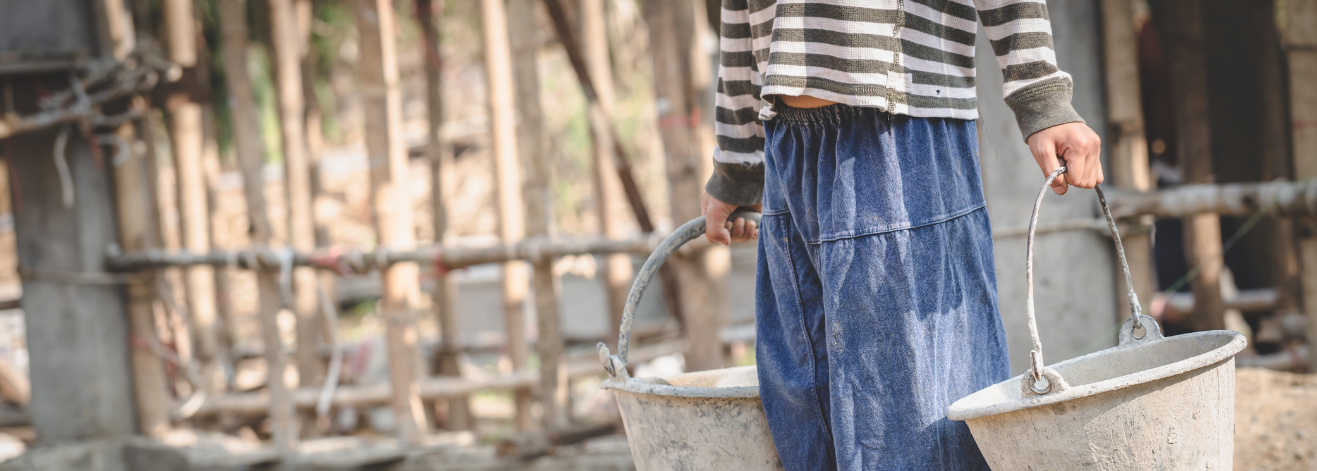
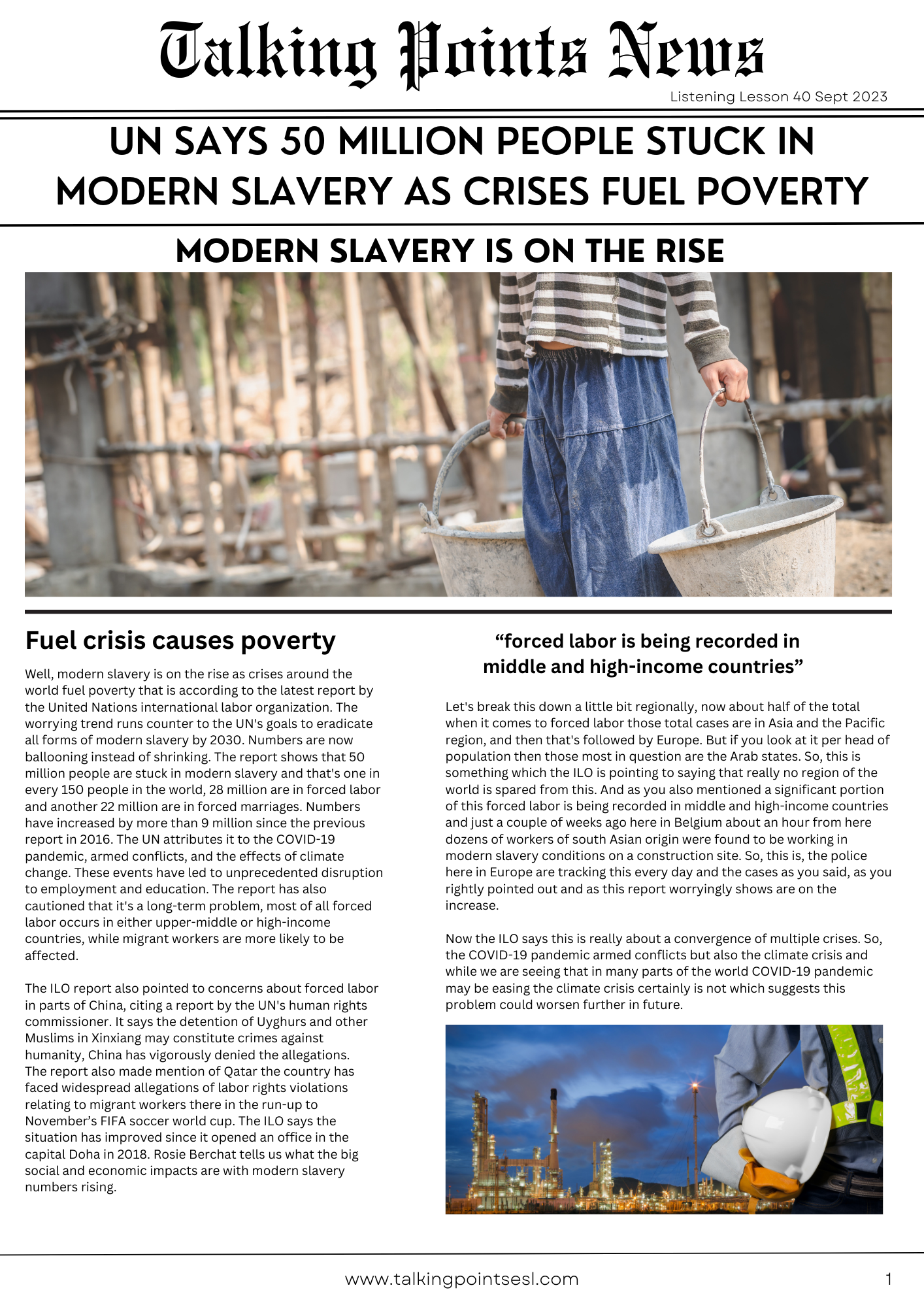
Well, modern slavery is on the rise as crises around the world fuel poverty that is according to the latest report by the United Nations international labor organization. The worrying trend runs counter to the UN's goals to eradicate all forms of modern slavery by 2030. Numbers are now ballooning instead of shrinking. The report shows that 50 million people are stuck in modern slavery and that's one in every 150 people in the world, 28 million are in forced labor and another 22 million are in forced marriages. Numbers have increased by more than 9 million since the previous report in 2016. The UN attributes it to the COVID-19 pandemic, armed conflicts, and the effects of climate change. These events have led to unprecedented disruption to employment and education. The report has also cautioned that it's a long-term problem, most of all forced labor occurs in either upper-middle or high-income countries, while migrant workers are more likely to be affected. The ILO report also pointed to concerns about forced labor in parts of China, citing a report by the UN's human rights commissioner. It says the detention of Uyghurs and other Muslims in Xinxiang may constitute crimes against humanity, China has vigorously denied the allegations. The report also made mention of Qatar the country has faced widespread allegations of labor rights violations relating to migrant workers there in the run-up to November’s FIFA soccer world cup. The ILO says the situation has improved since it opened an office in the capital Doha in 2018. Rosie Berchat tells us what the big social and economic impacts are with modern slavery numbers rising.
“forced labor is being recorded in middle and high-income countries”
Let's break this down a little bit regionally, now about half of the total when it comes to forced labor those total cases are in Asia and the Pacific region, and then that's followed by Europe. But if you look at it per head of population then those most in question are the Arab states. So, this is something which the ILO is pointing to saying that really no region of the world is spared from this. And as you also mentioned a significant portion of this forced labor is being recorded in middle and high-income countries and just a couple of weeks ago here in Belgium about an hour from here dozens of workers of south Asian origin were found to be working in modern slavery conditions on a construction site. So, this is, the police here in Europe are tracking this every day and the cases as you said, as you rightly pointed out and as this report worryingly shows are on the increase. Now the ILO says this is really about a convergence of multiple crises. So, the COVID-19 pandemic armed conflicts but also the climate crisis and while we are seeing that in many parts of the world COVID-19 pandemic may be easing the climate crisis certainly is not which suggests this problem could worsen further in future.
Questions:
Part 1: Comprehension
Watch and summarize the video thinking of who, what, when, where & why.
Part 2: True or False Questions
a) True or false – The UN had planned to eradicate all modern slavery by 2030. T/F
b) True or False – 28 million people work in forced labor camps. T/F
c) True or False – Qatar faced widespread allegations of labor rights violations relating to migrant workers. T/F
d) True or False – Most cases of forced labor are in Asia and the Pacific region. T/F
Part 3: Guess the meaning of unknown vocabulary
a) "Ballooning" (0:18 min)
b) "Unprecedented" (0:48 min)
c) "Vigorously" (1:20 min)
d) "Violations" (1:29 min)
Part 4: Dictation
a) Fill in the blanks (0:36 - 0:47 minutes) Numbers have increased ____________________________________________________ climate change.
b) Fill in the blanks (1:36 - 1:43 minutes) The ILO ______________________________________________________________________ in 2018.
c) Fill in the blanks (2:09 - 2:15 minutes) So, ____________________________________________________________________________from this.
Part 5: Talking Points
Part 6: Role play Scenarios
Scenario 1: Tourist in London
You are a tourist visiting London for the first time, and you need to travel from your hotel near King's Cross station to the Tower of London. Your partner is a local resident who has agreed to help you navigate the public transportation system. Roleplay the conversation as you plan your route and decide which mode of transportation to take.
Scenario 2: Commuting to Work
You are a commuter who takes the Tube every morning to get to your job in central London. You often have to deal with crowded trains and delays, and today is no exception. Roleplay the conversation with a fellow passenger as you discuss the challenges of commuting in a big city, and share tips on how to cope with the stresses of rush hour.
Scenario 3: Transportation Planner
You are a transportation planner for the city of London, and you have been tasked with improving public transportation in a particular neighborhood that has seen a recent influx of residents. You are meeting with a group of local community leaders to gather their feedback and suggestions.
Part 7: Writing Activity
What do you personally do to help climate change and reduce you carbon footprint?
Part 8: Critical Thinking: Tackling Climate Change.
Objective: To come up with a “greener” company or school strategy.
In groups create a 5 point strategy that would reduce your school or company’s carbon footprint and help reduce pollution in your country.
Then present it to the class, and finally reach a class consensus on the best 5 points.
Answers:
Part 1: Comprehension
This is a news report by CNA and they are reporting on the latest report from the UN which state that 50 million people are stuck in modern-day slavery as crisis around the world fuel poverty. The report states that the UN had a goal of eradicating all forms of modern slavery but instead numbers are ballooning. The UN has stated that the rise in the number is due to world crises like COVID and climate change. The report also states that 28 million are in forced labor and another 22 million in enforced marriages and proposes that most of all forced labor occurs in either upper-middle or high-income countries. Next, the report discusses the detention of Uyghurs and other Muslims in Xinxiang and states that this could be a crime against humanity. Lastly, the host talks with Rosie Berchat and she tells us about the social and economic impacts caused by modern slavery numbers rising. She gives an example of modern slavery on a Belgian construction site where dozens of workers of south Asian origin were found to be working in modern slavery conditions. She lastly points out that these rising cases are due to rising global crises.
Part 2: True or False
A: True B: False C: True D: False
Part 3: Guess the meaning of unknown vocabulary or phrases
a) "Ballooning" Answer: I think ballooning means to increase in number rapidly as the reporter states that the numbers of modern-day slaves are increasing dramatically and not shrinking.
b) "Unprecedented" Answer: I think it means never done or known before because in the video the speaker talks about how the world is currently experiencing crises such as COVID and climate change and these things have led to a situation around the world that no one has experienced before.
c) "Vigorously" Answer: I think this means putting a lot of strength or effort behind something because the reporter states that vigorously denies extremely damaging allegations, so China strongly refutes the claims made against them.
d) "Violations" Answer: I think that violation means an action that breaks the rules or acts against something because in the video the reporter talks about the possibility of Qatar breaking international labor laws when preparing for the World Cup.
Part 4: Dictation
a) Fill in the blanks (0:36 - 0:47 minutes) Numbers have increased by more than 9 million since the previous report in 2016. The UN attributes it to the COVID-19 pandemic, armed conflicts, and the effects of climate change.
b) Fill in the blanks (1:36 - 1:43 minutes) The ILO says the situation has improved since it opened an office in the capital Doha in 2018.
c) Fill in the blanks (2:09 - 2:15 minutes) So, this is something which the ILO is pointing to saying that really no region of the world is spared from this.
Part 7: Writing (example)
I do many things to help stop climate change and reduce my carbon footprint. I often use public transportation like buses and subways instead of driving a car. This helps reduce air pollution. At home, I make sure to save electricity by turning off lights and not using too much. I eat more vegetables and less meat because making meat creates a lot of carbon dioxide. I also buy food that is grown nearby and in season. This helps because food doesn't have to travel far to get to me. I recycle things like paper, glass, and plastic to reduce waste. Sometimes, I join activities like planting trees or cleaning beaches. These help the environment directly. I also try to learn about climate change and support things that are good for the environment. By doing these small things, I hope to make a big difference.


