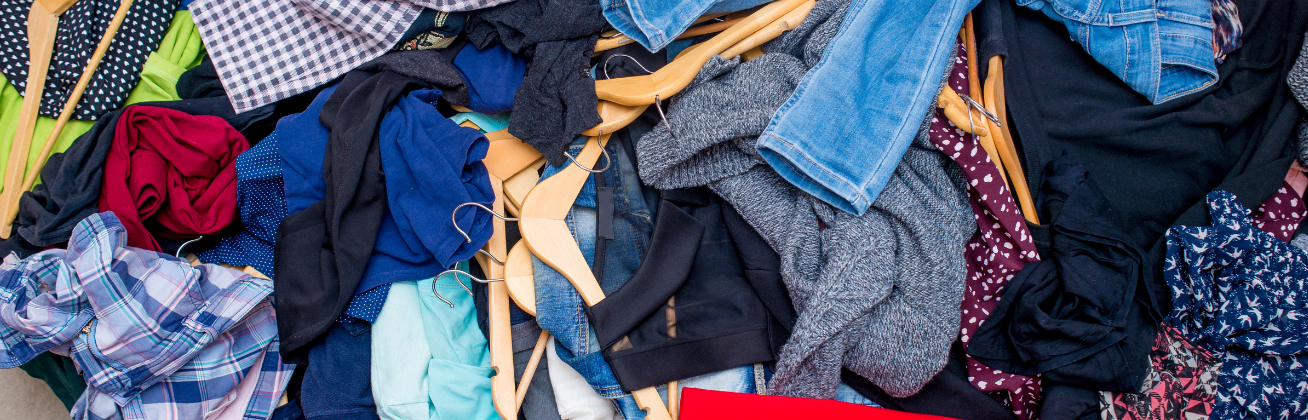


Everyday tens of millions of garments are tossed out to make way for the new. For consumers, they are out of sight out of mind, but the reality is much messier. Some of the discarded clothes enter a global second-hand supply chain that works to prolong their lives, but the rise of fast fashion is making the process increasingly difficult. Ghana was the world's biggest importer of used clothing in 2020 and here at Kantamanto markets in Accra, the capital of Ghana millions of garments arrive every week in massive bales. The market wholesalers and resellers do their best to try and sell as much as they can, but there's just too much clothing, it's unsellable. Some 40% of what enters Kantamanto is believed to leave here as waste creating a burden on the city. With the rise of fast fashion, garments fall apart after a few washes. Cheap synthetic blended fabrics are difficult to repurpose, and people are buying and throwing away too quickly. Since 2000 the average number of times a garment is worn before it's discarded has plummeted by 36 percent. Globally only less than one percent of old clothes are recycled into new ones.
This is one of the largest used clothes recycling factories run by Kanam International in Gujarat India. Young workers sort through piles of different garments and grading them into different categories. It's a complex process that extracts maximum out of used clothes and prolongs its life but ultimately very little of it is recycled. Can-Am International takes up to 120 million pounds a year of used textiles from North America, Europe, Japan, and Australia. Much of it gets chopped up and turned into things like car insulation mattress filling and cleaning cloths, but at some point, these products still end up in a landfill or incinerator.
“Companies are considering alternative models”
According to the UN, the fashion industry contributes between two percent and eight percent of global carbon emissions. Companies are considering alternative models that include capping growth, focusing on fewer higher-quality items and narrowing inventory to climate-friendly options though it's unclear how these approaches scale over time.
Questions:
Part 1: Comprehension
Watch and summarize the video thinking of who, what, when, where & why.
Part 2: True or False Questions
a) True or false – Large companies promote fast fashion. T/F
b) True or False – India was the world's biggest importer of used clothing in 2020. T/F
c) True or False – In general consumers are throwing away their clothes too quickly. T/F
d) True or False – Can-Am makes International up to 120 million pounds a year in the used clothes business. T/F
Part 3: Guess the meaning of unknown vocabulary
a) "Out of sight out of mind" (0:14 min)
b) "Bales" (0:43 min)
c) "Plummeted" (1:17 min)
d) "Chopped up" (2:01 min)
Part 4: Dictation
a) Fill in the blanks (0:43 - 0:54 minutes) The market ___________________________________________________________ it's unsellable.
b) Fill in the blanks (1:27 - 1:35 minutes) This is one ______________________________________________________________ India.
c) Fill in the blanks (2:11 - 2:19 minutes) According to the UN, ____________________________________________________carbon emissions.
Part 5: Talking Points
Part 6: Role play Scenarios
Scenario 1: Retailer and Customer.
You are a retailer who specializes in fast fashion. A customer comes into your store looking for a new outfit to wear to a party. As the retailer, you try to sell the customer on the latest trendy outfit that will be perfect for the occasion. The customer can express concerns about the environmental impact of fast fashion.
Scenario 2: Environmental Activist and Fashion Industry Representative
You are an environmental activist who is passionate about reducing the carbon emissions of the fashion industry. You arrange a meeting with a representative from a major fashion brand to discuss their efforts to become more sustainable. You have to try to convince the representative to take more action to reduce the carbon footprint of the brand.
Scenario 3: Sustainable Fashion Entrepreneur and Investor.
You are an entrepreneur who has started a sustainable fashion company that produces clothing made from eco-friendly materials. You have arranged a meeting with a potential investor to pitch your idea and try to secure funding for your business.
Part 7: Writing Activity
Describe how your fashion style has changed over the last 10 or 20 years.
Answers: Part 1: Comprehension
This video was created by Bloomberg Quicktake and their reporter Ekow Dontoh reports on the life cycle of clothing. The reporter states that less than 1% of clothing is recycled and that the life cycle of discarded clothing is having a huge impact on the environment. Most of the discarded clothing is overwhelming in countries like Ghana where old clothes are dumped in rivers throughout the country. The rise of fast fashion and a 36 percent decrease in the number of times a person wears a garment has led to Ghana’s markets being flooded with so many clothes that it is impossible to sell them all. The reporter also looks at the clothes recycling business in India where they report that although they receive a lot of clothes very little can be recycled. The reporter states that the fashion industry contributes between 2% and 8% of global carbon emissions with companies now looking at more climate-friendly alternatives.
Part 2: True or False
A: False B: False C: True D: False
Part 3: Guess the meaning of unknown vocabulary or phrases
a) "Out of sight out of mind" Answer: Out of sight out of mind means to forget something that can no longer be seen because in the video the reporter suggests that people donate their clothes and then they don’t really care where they end up.
b) "Bales" Answer: I think bales are large bundles of something, clothing in this situation because in the video they describe how the clothing is packaged and sent to Ghana from other countries.
c) "Plummeted" Answer: This means to decrease in value or amount because in the video the reporter talks about fast fashion and how consumers wear clothes for a shorter period of time than they used to.
d) "Chopped up" Answer: I think chopped up means cutting something into small pieces because in the report they describe how clothes that can be recycled would be used as cloths or car insulators and this would mean that the clothes would need to be cut into smaller pieces.
Part 4: Dictation
a) Fill in the blanks (0:33 - 0:59 minutes) The market wholesalers and resellers do their best to try and sell as much as they can, but there's just too much clothing, it's unsellable.
b) Fill in the blanks (1:27 - 1:35 minutes) This is one of the largest used clothes recycling factories run by Kanam International in Gujarat India.
c) Fill in the blanks (2:11 - 2:19 minutes) According to the UN, the fashion industry contributes between two percent and eight percent of global carbon emissions.
Part 7: Writing (example)
As a kid, I loved wearing bright, bold clothes that reflected my fun-loving personality. I would often wear colorful dresses with playful patterns, and my favorite accessories were bracelets and necklaces that added even more color to my outfits. As I grew older and entered my teenage years, I became more concerned with fitting in and following the latest fashion trends. I would often shop for new clothes with my friends and would feel the pressure to keep up with what everyone else was wearing. However, as I entered adulthood, I started to shift my focus towards more classic and timeless pieces that could be worn for years. I began to appreciate the value of investing in high-quality items that would last, rather than constantly buying new things. I also became more aware of the impact of the fashion industry on the environment and started to make more sustainable choices, such as buying secondhand or choosing pieces made from eco-friendly materials.


