



In recent years some of the world's biggest companies have discarded depth and detail to de-brand. Burger King lost weight, Rolling Stone found a cleaner edge, VW shared its depth and shadow, as did Kia, Pfizer, Nissan, Durex, Intel, Toyota, and a host of other major brands. Even the munchable hero Julius Pringle had a flattening make under with shaved head dyed mustache dilated eyes and new pre-sprung eyebrows. But what prompted this landslide of logo de-branding? Several interlocking forces are at work. The most immediate of which is the pressure of mobile-first design. Clients used to ask can you make the logo bigger now the trick is to shrink an entire identity into a tiny digital box. Such pixel pressure usually means returning to the 2D look of old, of course, this 2D look was more or less the norm until computers took over and design inflation spiraled out of control. Anyone who has over-filtered an Instagram sunset knows the seductive lure of visual excess and it's a seduction to which the pros are not immune. The ability to round corners, drop shadows, customize gradients, and create complex lighting effects can easily overpower the creative brief and often does. So many recent rebrands represent a turn to sobriety after a spasm of software-re-betted intoxication.
There was also the question of maturity many of our biggest brands were born in a spirit of playful innocence that burst forth from their early branding. Take Foursquare, Airbnb, GoDaddy, Google as these companies grew and the stakes rose so their logos were obliged to mature from cartoonish to corporate, flamboyant to flat, wacky to bland, illustrating the power of de-branding to professionalize. And then there is fashion company graphics are as susceptible to trends as any other design as we see in the stampede of fashion's little black dress logos heralded by Yves Saint Laurent in 2012 and followed by Diane Von Furstenberg, Calvin Klein, Berluti, Burberry and Baume. Yet the most intriguing element of the de-branded logo is its potential to become a portal. Warner Brothers didn't just strip back its theatrical golden guilt it unlocked a world of possibility that's increasingly vital to brands that span genres, showcase variety, or offer 31 flavors.
“de-branding will be with us for a while”
For all these reasons it seems likely that de-branding will be with us for a while but who knows when the pendulum will swing and the trend revert to detail complexity and personality. After all, once a critical mass is zagged against the prevailing zig, the margin becomes mainstream the template flips and the dance begins afresh. I’m Ben Schoot the branding and advertising columnist for Bloomberg opinion.
Questions:
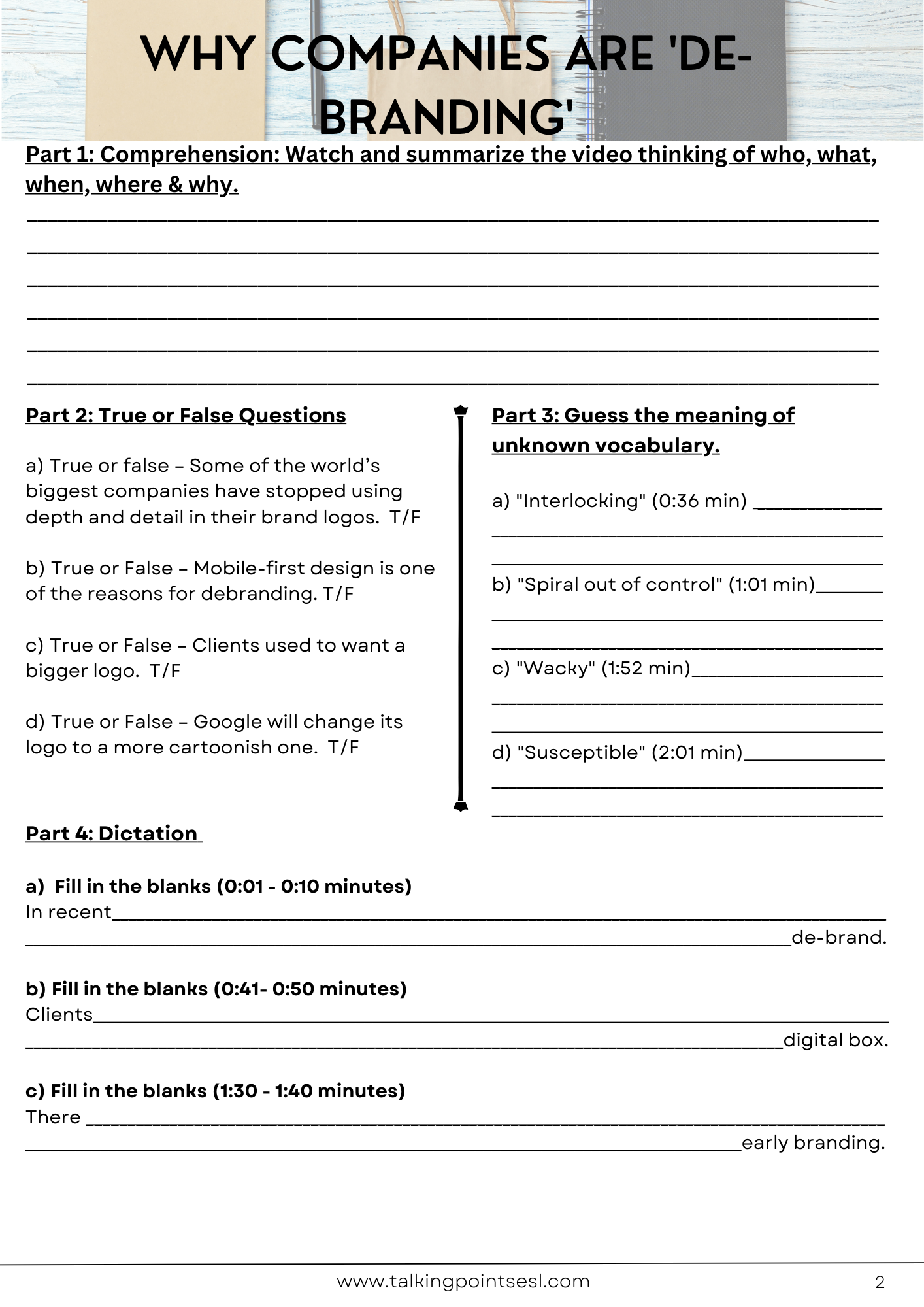
Part 1: Comprehension
Watch and summarize the video thinking of who, what, when, where & why.
Part 2: True or False Questions
a) True or false – Some of the world’s biggest companies have stopped using depth and detail in their brand logos. T/F
b) True or False – Mobile-first design is one of the reasons for debranding. T/F
c) True or False – Clients used to want a bigger logo. T/F
d) True or False – Google will change its logo to a more cartoonish one. T/F
Part 3: Guess the meaning of unknown vocabulary.
a) "Interlocking" (0:36 min)
b) "Spiral out of control" (1:01 min)
c) "Wacky" (1:52 min)
d) "Susceptible" (2:01 min)
Part 4: Dictation
a) Fill in the blanks (0:01 - 0:10 minutes) In recent__________________________________________________de-brand.
b) Fill in the blanks (0:41- 0:50 minutes) Clients ____________________________________________________digital box.
c) Fill in the blanks (1:30 - 1:40 minutes)There ______________________________________________________early branding.
Part 5: Talking Points
1. What do you think of the video?
2. What is a brand?
3. Why do you think companies are debranding?
4. Do you think debranding makes products more attractive?
5. Do you work for a company that has debranded?
6. What are some of your favorite brands? Why do you like them?
7. Are there any brands you hate? Why do you not like them?
8. How important is it for a company to have a good brand name or logo?
9. What do you think companies think about when creating a brand?
10. In what ways could a brand be damaged or ruined?
Part 6: Role play Scenarios
Scenario 1: Branding Consultant and Client
The branding consultant advises a client, a company representative, on rebranding their logo. The client is considering de-branding and seeks to understand its benefits and risks. The consultant offers insights on de-branding trends, mobile-first design, and the need for maturity in branding. They discuss the advantages and disadvantages of de-branding, considering the client's industry and audience.
Scenario 2: Marketing Team Meeting
The marketing team, responsible for branding and advertising, reviews recent rebranding efforts of major brands and discusses their implications for their own strategy. They debate de-branding trends, mobile-first design impact, and its benefits and risks for their brand. They brainstorm ideas to include de-branding in future campaigns and consider its effect on their target audience.
Scenario 3: Brand Manager and Design Team
The brand manager, leading the company's branding efforts, discusses with the design team about rebranding to follow the de-branding trend. The team considers changes like simplifying the logo and its impact on the company's identity. Together, they explore designs to create a new logo that aligns with de-branding yet keeps the brand's essence.
Part 7: Writing Activity
What is your favorite clothing brand? why? are they any brands you don’t like ? why?
Part 8: Critical Thinking - Best brands.
Objective: In groups order the brands that you think are the best to the worst. Give reasons to support your answer considering:
brand image, customers, cost of products, logo design, have they been de-branded recently?
1. Nike, 2. Gucci, 3. Pringles, 4. Kia, 5. Apple, 6. One other you team can pick.
Then come together as a class and reach a consensus on the best brands.
Answers:
Part 1: Comprehension
This video was created by an American new company and they are reporting on the latest debranding trend that many large companies are doing. The reporter talks about the reasons why many of the big companies are changing their brand logos and he gives examples stating that Burger Kind lost some weight and even the Pringles logo had a makeunder. One of the reasons for the rebranding was to highlight a sign of maturity from some of the bigger brands where their new brand image moves away from playful marketing strategies to a more professional approach. Additionally, it comes down to a recent trend and the reporter states that it may even go to more complex designs in the future.
Part 2: True or False
A: True B: True C: True D: False
Part 3: Guess the meaning of unknown vocabulary or phrases
a) "Duplicate" Answer: I think duplicate means to make an exact copy of something because Bob talks about models and states that if it can be in miniature format then it can be made into a kit meaning that a duplicate of the miniature could be made.
b) "Cup of tea" Answer: In this situation, it means something that is suited to a person’s taste or preference because in the video the speaker talks about having a variety of different types of models to suit everyone.
c) "Confined" Answer: I think confined means to be stuck in one location as the speaker talks about the effects that COVID had on hobby trends and states that most people had to stay at home.
d) "Reliving their youth" Answer: I think this means living through a similar time in your life again. For example, the video talks about getting back into hobbies that people used to do when they were teenagers so it feels like reliving that period of time.
Part 4: Dictation
a) Fill in the blanks (0:01 - 0:10 minutes) In recent years some of the world's biggest companies have discarded depth and detail to de-brand.
b) Fill in the blanks (0:41- 0:50 minutes) Clients used to ask can you make the logo bigger now the trick is to shrink an entire identity into a tiny digital box.
c) Fill in the blanks (1:30 - 1:40 minutes) There was also the question of maturity many of our biggest brands were born in a spirit of playful innocence that burst forth from their early branding.
Part 7: Writing (example)
I really like Nike as a clothing brand. The reason is that Nike offers a wide range of sportswear and is known for its innovative designs and quality. Their products are not only functional but also fashionable, making them a popular choice for both athletes and casual wearers. On the other hand, Adidas doesn't appeal to me as much. Although Adidas is also a major sportswear brand with a strong heritage, I find their designs less appealing compared to Nike's. Additionally, some people might find Adidas' fit and comfort level not as satisfying as Nike's, which can be a deciding factor in choosing sportswear.


