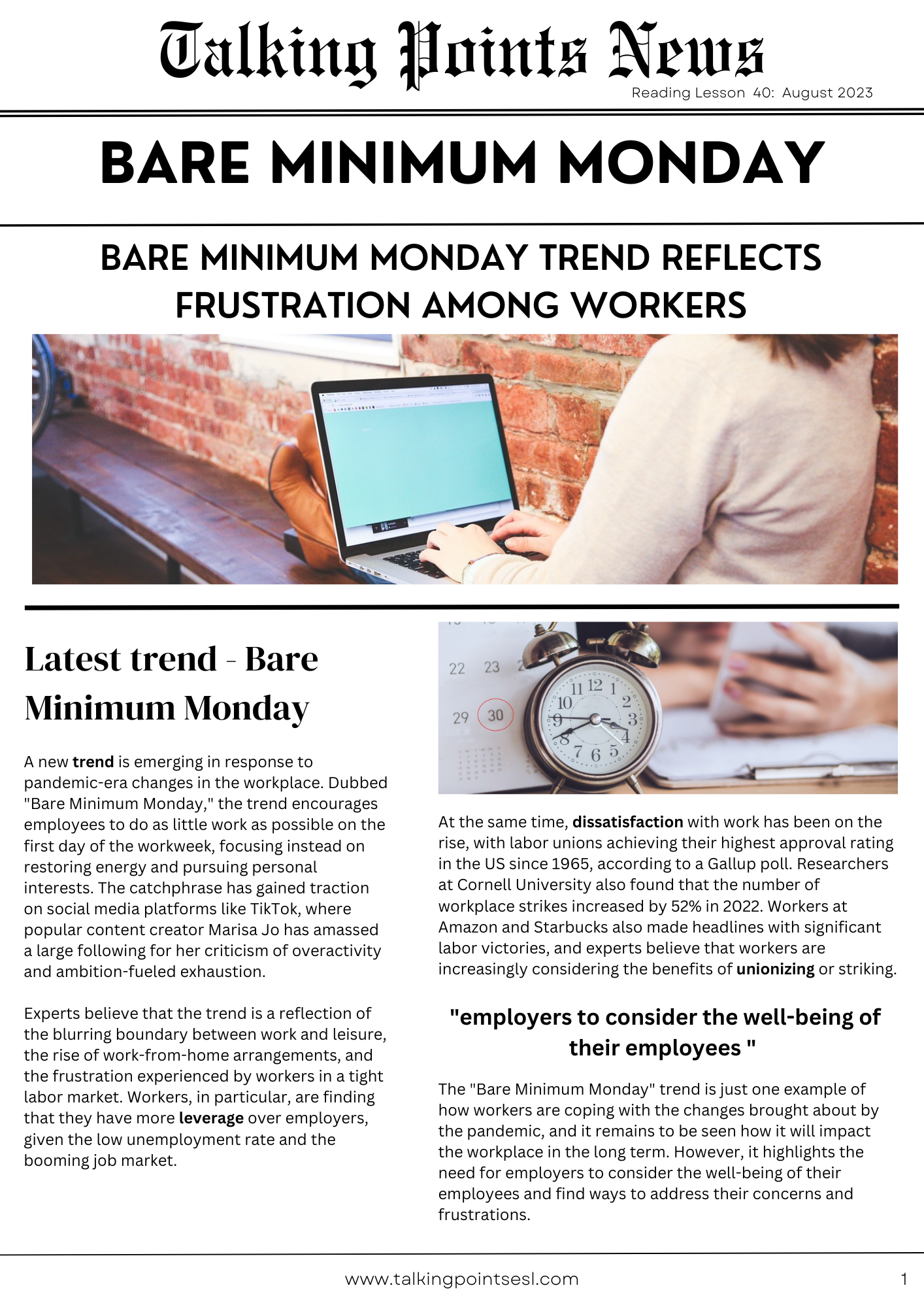
Bare Minimum Monday Trend Reflects Frustration Among Workers.
Latest trend - Bare Minimum Monday.
Script:
A new trend is emerging in response to pandemic-era changes in the workplace. Dubbed "Bare Minimum Monday," the trend encourages employees to do as little work as possible on the first day of the workweek, focusing instead on restoring energy and pursuing personal interests. The catchphrase has gained traction on social media platforms like TikTok, where popular content creator Marisa Jo has amassed a large following for her criticism of overactivity and ambition-fueled exhaustion.Experts believe that the trend is a reflection of the blurring boundary between work and leisure, the rise of work-from-home arrangements, and the frustration experienced by workers in a tight labor market. Workers, in particular, are finding that they have more leverage over employers, given the low unemployment rate and the booming job market.
At the same time, dissatisfaction with work has been on the rise, with labor unions achieving their highest approval rating in the US since 1965, according to a Gallup poll. Researchers at Cornell University also found that the number of workplace strikes increased by 52% in 2022. Workers at Amazon and Starbucks also made headlines with significant labor victories, and experts believe that workers are increasingly considering the benefits of unionizing or striking.
"employers to consider the well-being of their employees"
The "Bare Minimum Monday" trend is just one example of how workers are coping with the changes brought about by the pandemic, and it remains to be seen how it will impact the workplace in the long term. However, it highlights the need for employers to consider the well-being of their employees and find ways to address their concerns and frustrations.
Questions:
Part 1: Comprehension
Read and summarize the article thinking of who, what, when, where & why.
Part 2: True or False Questions
a) True or False - The "Bare Minimum Monday" trend encourages employees to focus on personal interests instead of work. T/F
b) True or False - Experts believe that the trend related to laziness. T/F
c) True or False - The number of workplace strikes increased by 25% in 2023. T/F
d) True or False - The article suggests that employers need to consider the well-being of their employees more. T/F
Part 3: Guess the meaning of unknown vocabulary/phrases.
a) "Trend"
b) "Leverage"
c) "Dissatisfaction”
d) "Unionizing"
Part 3b: Vocabulary in Use - Write an example sentence using the words from 3a.
a) Trend:
b) Leverage:
c) Dissatisfaction:
d) Unionizing:
Part 5: Talking Points
Part 6: Role play Scenarios
In this scenario, the students can reflect on their own work experiences and discuss how they cope with stress and burnout. They can share personal anecdotes and offer tips and advice to their peers. This activity can encourage self-reflection and empathy for others who may be struggling in the workplace.
In this scenario, the students can take turns playing the role of an employee and a manager. The employee is experiencing burnout and would like to propose the idea of "Bare Minimum Monday" to the manager as a solution. The manager is skeptical and concerned about the impact on productivity. The students can practice using persuasive language and negotiating skills to reach a compromise.
In this scenario, the students can be divided into pairs and discuss their thoughts on the "Bare Minimum Monday" trend. They can explore the pros and cons of the idea, share personal experiences, and discuss the potential long-term impacts on the workplace.
Part 7: Writing Activity Present Simple Tense
Describe a typical Monday for you, what do you and how do you usually feel?
Part 8: Critical Thinking - Labour Union
Work in groups and discuss the pros and cons of working at your company.
Group A are pro company and group B are union members who are fighting for improvements and additional benefits.
lastly, come together and reach a consensus on improvements the company should make in order to keep their employees happy.
Answers:
Part 1: Comprehension
The main idea of this article is that a new trend called "Bare Minimum Monday" has emerged as a response to pandemic-era changes in the workplace, where workers are encouraged to do as little work as possible on the first day of the workweek to restore energy and pursue personal interests. The article suggests that this trend reflects the blurring boundary between work and leisure, the rise of work-from-home arrangements, and the frustration experienced by workers in a tight labor market. The article also discusses the increase in dissatisfaction with work, the rise of labor unions, and workplace strikes as workers consider the benefits of unionizing or striking. The article was likely written to inform readers about this emerging trend and its potential impact on the workplace while highlighting the need for employers to consider the well-being of their employees and find ways to address their concerns and frustrations.
Part 2: True or False
A: True B: False C: False D: True
Part 3a: Guess the meaning of unknown vocabulary or phrases.
A) "Trend" Answer: This word refers to a general direction or tendency of something that is currently popular or widespread. In the context of the article, the "Bare Minimum Monday" trend is a response to pandemic-era changes in the workplace that encourages employees to focus on restoring energy and pursuing personal interests.
b) "Leverage" Answer: This word refers to the power or ability to influence or achieve a desired outcome. In the context of the article, workers have more leverage over employers due to the low unemployment rate and booming job market.
c) "Dissatisfaction" Answer: This refers to a feeling of unhappiness or dissatisfaction with something. In the context of the article, dissatisfaction with work has been on the rise, with labor unions achieving their highest approval rating in the US since 1965, according to a Gallup poll.
d) "Unionizing" Answer: This refers to the act of organizing workers to form a union to collectively negotiate with employers for better working conditions, pay, and benefits. In the context of the article, workers at Amazon and Starbucks made headlines with significant labor victories, and experts believe that workers are increasingly considering the benefits of unionizing or striking.
Part 3b: Vocabulary in Use - Write an example sentence using the words from 3a. (examples)
a) Trend: The current fashion trend is all about vintage clothing.
b) Leverage: The company plans to leverage its existing customer base to expand into new markets.
c) Dissatisfaction: The customer expressed their dissatisfaction with the product's quality in a strongly worded email.
d) Unionizing: The employees are considering unionizing to negotiate for better working conditions.
Part 7: Writing (example)
My typical Monday kicks off with a rush to beat the traffic and get to the office on time. Once I'm at my desk, it's all about diving into emails and planning out the tasks for the week ahead. We usually start the day with a team meeting to align our goals and priorities. As the hours roll on, I work on various projects, attend meetings, and collaborate with my coworkers. By the afternoon, I often find my initial burst of energy waning a bit, so I take a coffee break to recharge. That's when the Monday blues can creep in as I start to long for the weekend's freedom. But I push through with determination, aiming to accomplish my weekly goals, and there's a sense of accomplishment as the day comes to a close.