Chinese Vlogger Fined for Cooking and Eating Great White Shark.
Eating Great White Shark.
Script:
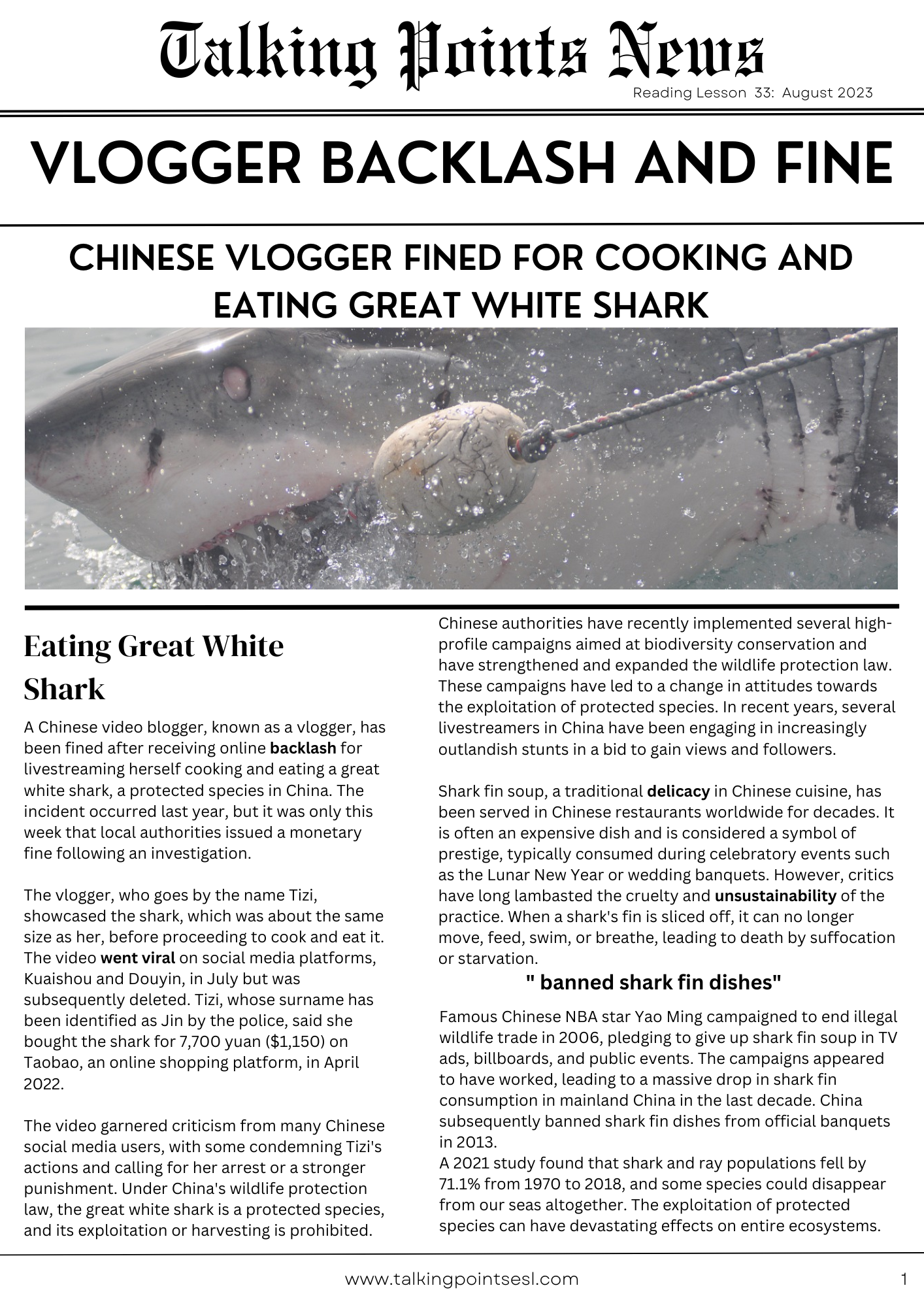
A Chinese video blogger, known as a vlogger, has been fined after receiving online backlash for livestreaming herself cooking and eating a great white shark, a protected species in China. The incident occurred last year, but it was only this week that local authorities issued a monetary fine following an investigation.The vlogger, who goes by the name Tizi, showcased the shark, which was about the same size as her, before proceeding to cook and eat it. The video went viral on social media platforms, Kuaishou and Douyin, in July but was subsequently deleted. Tizi, whose surname has been identified as Jin by the police, said she bought the shark for 7,700 yuan ($1,150) on Taobao, an online shopping platform, in April 2022.The video garnered criticism from many Chinese social media users, with some condemning Tizi's actions and calling for her arrest or a stronger punishment. Under China's wildlife protection law, the great white shark is a protected species, and its exploitation or harvesting is prohibited.
Chinese authorities have recently implemented several high-profile campaigns aimed at biodiversity conservation and have strengthened and expanded the wildlife protection law. These campaigns have led to a change in attitudes towards the exploitation of protected species. In recent years, several livestreamers in China have been engaging in increasingly outlandish stunts in a bid to gain views and followers.Shark fin soup, a traditional delicacy in Chinese cuisine, has been served in Chinese restaurants worldwide for decades. It is often an expensive dish and is considered a symbol of prestige, typically consumed during celebratory events such as the Lunar New Year or wedding banquets. However, critics have long lambasted the cruelty and unsustainability of the practice. When a shark's fin is sliced off, it can no longer move, feed, swim, or breathe, leading to death by suffocation or starvation.
"banned shark fin dishes"
Famous Chinese NBA star Yao Ming campaigned to end illegal wildlife trade in 2006, pledging to give up shark fin soup in TV ads, billboards, and public events. The campaigns appeared to have worked, leading to a massive drop in shark fin consumption in mainland China in the last decade. China subsequently banned shark fin dishes from official banquets in 2013.A 2021 study found that shark and ray populations fell by 71.1% from 1970 to 2018, and some species could disappear from our seas altogether. The exploitation of protected species can have devastating effects on entire ecosystems.
Questions:
Part 1: Comprehension
Read and summarize the article thinking of who, what, when, where & why.
Part 2: True or False Questions
a) True or False - Great white sharks are a protected species in China. T/F
b) True or False - Tizi, the Chinese vlogger, bought the great white shark for around $1100. T/F
c) True or False - China banned shark fishing because it is dangerous. T/F
d) True or False - Chinese NBA star Yao Ming loves to eat shark fins. T/F
Part 3a: Guess the meaning of unknown vocabulary/phrases.
a) "Backlash"
b) "Go viral"
c) "Delicacy"
d) "Unsustainability"
Part 3b: Vocabulary in Use - Write an example sentence using the words from 3a.
a) Backlash:
b) Go viral:
c) Delicacy:
d) Unsustainability:
Part 5: Talking Points
Part 6: Role play Scenarios
You are a conservation officer in China, and you have just received a report that a vlogger has livestreamed herself cooking and eating a great white shark. You need to investigate the incident and decide what actions to take. Then call the vlogger (partner)
You are members of a Chinese environmental group, and you are planning a campaign to raise awareness about the need to protect endangered species. You need to come up with creative ideas for the campaign, including slogans, posters, and social media posts.
You are a Chinese restaurant owner, and you have recently added shark fin soup to your menu. One of your customers has asked you about the sustainability of the dish, and you need to explain the issue to them.
Part 7: Writing Activity
Past Tense - Write about the most interesting food you have ever eaten, how did it taste? where did you eat it? who did you eat it with?
Part 8: Critical Thinking - Social Responsibility
Do you think social media companies should be responsible for the things people post online? Why or why not?
In groups discuss this question, then come back as a class and reach a consensus on who should be responsible for what is posted online and why?
Answers:
Part 1: Comprehension
The main idea of the article is that a Chinese vlogger, known as Tizi, has been fined for cooking and eating a great white shark, which is a protected species in China. The incident occurred in July 2022, and the video went viral on social media platforms before being deleted. Tizi received backlash from many Chinese social media users, who criticized her actions and called for her arrest or a stronger punishment. The article highlights the increasing concern in China over the exploitation of protected species, and the campaigns aimed at biodiversity conservation that have been implemented by Chinese authorities. The article also discusses the controversy surrounding shark fin soup, a traditional delicacy in Chinese cuisine, and its impact on shark and ray populations, which have fallen by 71.1% from 1970 to 2018.
Part 2: True or False
A: True B: True C: False D: False
Part 3a: Guess the meaning of unknown vocabulary or phrases.
a) "Backlash" Answer: I think this is a strong and usually negative reaction to something that goes against the norm or expectations because in the article they talk about how people reacted angrily to the vloggers video.
b) "Go viral" Answer: I think it means that something quickly becomes very popular and widely shared on the internet or social media. In the article they talk about how this vloggers video was shared widely online and how many people saw it.
c) "Delicacy" Answer: I think it means a highly valued and sought-after food item, often rare or expensive, and considered a luxury or gourmet food. Shark fin soup is considered a delicacy in Chinese cuisine, typically consumed during celebratory events such as the Lunar New Year or wedding banquets.
d) "Unsustainability" Answer: I think it means the inability to be maintained or continued over time without causing damage to the environment or depleting natural resources. Critics have long lambasted the cruelty and unsustainability of the practice of serving shark fin soup, as it leads to the exploitation and endangerment of shark populations.
Part 3b: Vocabulary in Use - Write an example sentence using the words from 3a. (examples)
a) Backlash: There was a significant backlash from the community when the company announced layoffs.
b) Go viral: The funny cat video she posted on social media started to go viral overnight, with millions of views and shares.
c) Delicacy: Escargot is a French delicacy that involves cooking and eating snails.
d) Unsustainability: The excessive use of single-use plastics is contributing to the unsustainability of our environment.
Part 7: Writing (example)
One of the most interesting foods I've ever tried was frogs' legs and snails during a trip to France. I was dining at a charming bistro in Paris with a group of friends who were equally curious about French cuisine. The frogs' legs were surprisingly tender and had a mild, chicken-like flavor, though they were subtly infused with the savory herbs in the sauce. The snails, prepared as escargot, were bathed in garlic butter, imparting a rich, buttery, and garlicky taste that contrasted the chewy texture of the snails themselves. It was a memorable culinary adventure, and the ambiance of the quaint Parisian restaurant added to the experience, making it one of the most intriguing and delicious meals I've ever had.