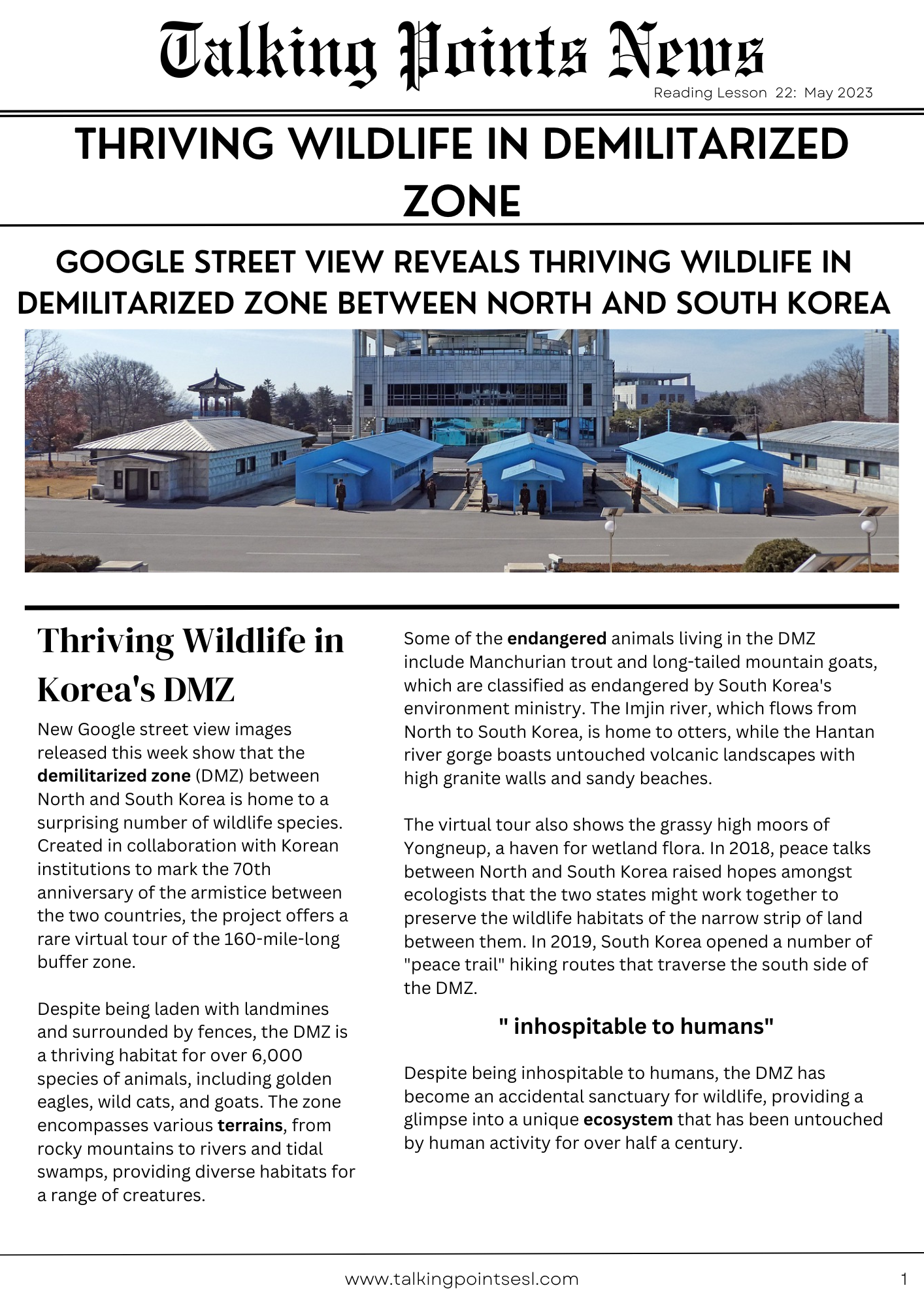
Google Street View Reveals Thriving Wildlife in Demilitarized Zone Between North and South Korea.
Thriving Wildlife in Korea's DMZ.
Script:
New Google street view images released this week show that the demilitarized zone (DMZ) between North and South Korea is home to a surprising number of wildlife species. Created in collaboration with Korean institutions to mark the 70th anniversary of the armistice between the two countries, the project offers a rare virtual tour of the 160-mile-long buffer zone.Despite being laden with landmines and surrounded by fences, the DMZ is a thriving habitat for over 6,000 species of animals, including golden eagles, wild cats, and goats. The zone encompasses various terrains, from rocky mountains to rivers and tidal swamps, providing diverse habitats for a range of creatures.
Some of the endangered animals living in the DMZ include Manchurian trout and long-tailed mountain goats, which are classified as endangered by South Korea's environment ministry. The Imjin river, which flows from North to South Korea, is home to otters, while the Hantan river gorge boasts untouched volcanic landscapes with high granite walls and sandy beaches.The virtual tour also shows the grassy high moors of Yongneup, a haven for wetland flora. In 2018, peace talks between North and South Korea raised hopes amongst ecologists that the two states might work together to preserve the wildlife habitats of the narrow strip of land between them. In 2019, South Korea opened a number of "peace trail" hiking routes that traverse the south side of the DMZ.
"inhospitable to humans"
Despite being inhospitable to humans, the DMZ has become an accidental sanctuary for wildlife, providing a glimpse into a unique ecosystem that has been untouched by human activity for over half a century.
Questions:
Part 1: Comprehension
Read and summarize the article thinking of who, what, when, where & why.
Part 2: True or False Questions
a) True or False - The Google street view project was created to commemorate the 70th anniversary of the end of the Korean War. T/F
b) True or False - The DMZ is not a suitable habitat for wildlife due to the presence of landmines and fences. T/F
c) True or False - The Imjin river in the DMZ is home to otters. T/F
d) True or False - The "peace trail" hiking routes were opened by North Korea in 2019. T/F
Part 3a: Guess the meaning of unknown vocabulary/phrases.
a) "Demilitarized zone"
b) "Terrains"
c) "Endangered"
d) "Ecosystem"
Part 3b: Vocabulary in Use: Write an example sentence using the words from 3a.
a) Demilitarized zone:
b) Terrains:
c) Endangered:
d) Ecosystem:
Part 5: Talking Points
Part 6: Role play Scenarios
In this scenario, one student plays the role of an ecologist and the other plays the role of a North Korean official. The ecologist wants to discuss ways to preserve the wildlife habitats in the DMZ, while the North Korean official is skeptical about the benefits of preservation. The conversation should focus on the present simple tense, as they discuss the current state of the DMZ.
In this scenario, one student plays the role of a tour guide and the other plays the role of a tourist. The tour guide takes the tourist on a virtual tour of the DMZ using the Google street view images. They describe the various habitats and wildlife species in the DMZ, using present simple tense to talk about the current state of the area.
In this scenario, one student plays the role of a wildlife expert and the other plays the role of a reporter. The reporter wants to learn more about the diverse wildlife species in the DMZ and how they have adapted to the unusual environment. The conversation should use present simple tense to describe the current state of the DMZ and the various habitats and species found there.
Part 7: Writing Activity
Present Simple Tense - Do you like animals? What are your favorite animals? Why?
Part 8: Critical Thinking - Endangered Animals
Work in groups and research which animals are the most endangered. Then, pick one and create a presentation outlining:
What the animal is.
Where it can be found.
Why it’s endangered.
What can be done to help it.
After all presentations have finished discuss what can be done to collectively help all endangered animals.
Answers:
Part 1: Comprehension
The main idea of the article is that Google Street View has revealed a thriving wildlife habitat in the demilitarized zone (DMZ) between North and South Korea, despite the zone being laden with landmines and surrounded by fences. The article discusses the diverse habitats found in the DMZ and the various endangered animal species that call it home. It also mentions the hopes for preserving the wildlife habitats and ecosystems in the DMZ, and the accidental sanctuary it has become for wildlife due to its inhospitable conditions for humans. The article was likely written to inform readers about the surprising discovery of a thriving wildlife habitat in a zone that has been a symbol of conflict and tension between North and South Korea for over half a century.
Part 2: True or False
A: True B: False C: True D: False
Part 3a: Guess the meaning of unknown vocabulary or phrases.
a) "Demilitarized zone" Answer: This is an area in which military forces or operations are not allowed. In the context of the article, it refers to the 160-mile-long buffer zone between North and South Korea.
b) "Terrains" Answer: This is a stretch of land, especially with regard to its physical features. In the context of the article, it refers to the various types of landscapes found in the DMZ, such as rocky mountains, rivers, and tidal swamps.
c) "Endangered" Answer: I think this something at risk of extinction or destruction. In the context of the article, it refers to animal species that are classified as being in danger of becoming extinct, such as Manchurian trout and long-tailed mountain goats.
d) "Proposition" Answer: This is a biological community of interacting organisms and their physical environment. In the context of the article, it refers to the unique natural habitat of the DMZ, which has been untouched by human activity for over half a century and provides a sanctuary for wildlife.
Part 3b: Vocabulary in Use: Write an example sentence using the words from 3a. (examples)
a) Demilitarized zone: The Demilitarized Zone in Korea serves as a buffer between North and South Korea, where tensions are palpable despite its name.
b) Terrains: Hiking enthusiasts often seek out various terrains, from rugged mountains to dense forests, to challenge their skills and enjoy diverse natural landscapes.
c) Endangered: Tigers are beautiful animals that need protection because they're endangered.
d) Ecosystem: An ecosystem is like a big puzzle where all the plants and animals work together to make a balanced and healthy environment.
Part 7: Writing (example)
Dogs are my favorite animals! I really like them because they are so loyal. They always show love and excitement when they see you, no matter how your day was. Dogs are also very friendly and enjoy being close to people. They come in different sizes and have different personalities, so there's a dog for everyone. Besides being good friends, some dogs can also learn to help people with special needs or protect them. Dogs are playful and happy, and their happiness makes you happy too. That's why I like dogs so much!