New Study Reveals Gen Z's Top Concerns
Gen z highlight their concerns
Script:
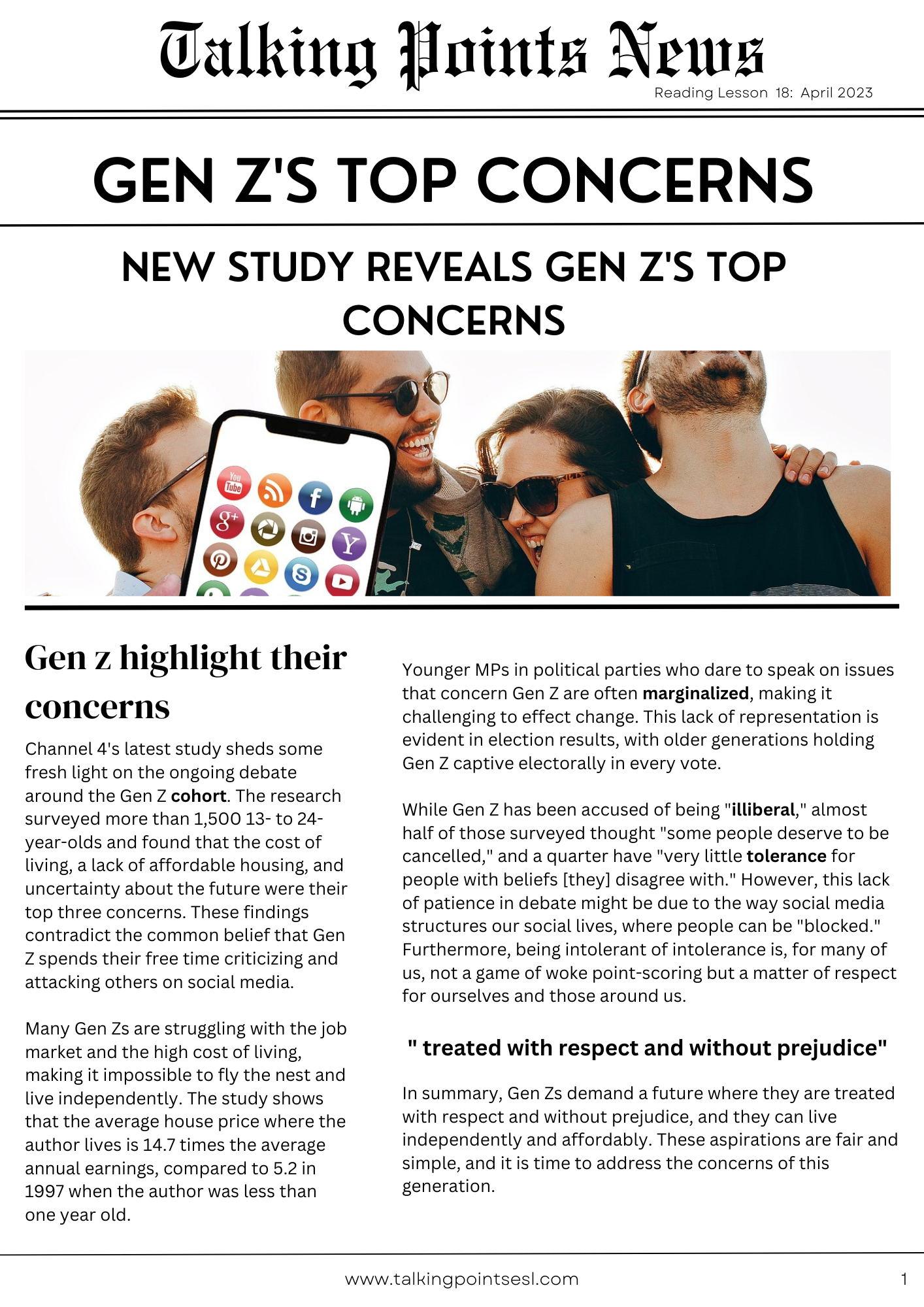
Channel 4's latest study sheds some fresh light on the ongoing debate around the Gen Z cohort. The research surveyed more than 1,500 13- to 24-year-olds and found that the cost of living, a lack of affordable housing, and uncertainty about the future were their top three concerns. These findings contradict the common belief that Gen Z spends their free time criticizing and attacking others on social media. Many Gen Zs are struggling with the job market and the high cost of living, making it impossible to fly the nest and live independently. The study shows that the average house price where the author lives is 14.7 times the average annual earnings, compared to 5.2 in 1997 when the author was less than one year old.
Younger MPs in political parties who dare to speak on issues that concern Gen Z are often marginalized, making it challenging to effect change. This lack of representation is evident in election results, with older generations holding Gen Z captive electorally in every vote. While Gen Z has been accused of being "illiberal," almost half of those surveyed thought "some people deserve to be cancelled," and a quarter have "very little tolerance for people with beliefs [they] disagree with." However, this lack of patience in debate might be due to the way social media structures our social lives, where people can be "blocked." Furthermore, being intolerant of intolerance is, for many of us, not a game of woke point-scoring but a matter of respect for ourselves and those around us.
"treated with respect and without prejudice"
In summary, Gen Zs demand a future where they are treated with respect and without prejudice, and they can live independently and affordably. These aspirations are fair and simple, and it is time to address the concerns of this generation.
Questions:
Part 1: Comprehension
Read and summarize the article thinking of who, what, when, where & why.
Part 2: True or False Questions
a) True or False - According to the study, the top three concerns of Gen Z are the cost of living, lack of affordable housing, and uncertainty about the future. T/F
b) True or False - The article suggests that Gen Z spends most of their free time criticizing and attacking others on social media. T/F
c) True or False -Young MPs like to speak on Gen Z issues. T/F
d) True or False - The lack of patience in debate among Gen Z may be due to the way social media structures our social lives.T/F
Part 3a: Guess the meaning of unknown vocabulary/phrases.
a) "Cohort"
b) "Marginalized"
c) "Illiberal"
d) "Tolerance"
Part 3b: Vocabulary in Use: Write an example sentence using the words from 3a.
a) Cohort:
b) Marginalized:
c) Illiberal:
d) Tolerance:
Part 5: Talking Points
Part 6: Role play Scenarios
Work in pairs, with one student playing the role of a Gen Zer and the other a concerned citizen. The Gen Zer can express their worries about the high cost of living, lack of affordable housing, and uncertainty about the future, while the concerned citizen can offer suggestions and solutions.
Work in pairs, with one student representing Gen Z and the other representing older generations. Discuss issues like representation, marginalization, and the election results, and debate ways to effect change.
Work in pairs, with one student playing the role of a Gen Zer and the other a critic. The Gen Zer can express their opinion on "cancel culture" and intolerance, while the critic can offer a counterpoint and engage in a debate.
Part 7: Writing Activity
Compare and Contrast - What are the advantages and disadvantages of social media?
Part 8: Critical Thinking - Social Concerns.
In the article above Gen Z highlight some of the concerns they face. In groups discuss the 3 biggest social concerns that you have in your country and list them in order from the most concerning to the least. Then come together as a class and discuss them, and reach a consensus on the list. Once you have completed the list discuss ways to solve the issues.
Answers:
Part 1: Comprehension
The main idea of the article is to present the results of a study conducted by Channel 4 that sheds light on the concerns of the Gen Z cohort, who are facing high living costs, lack of affordable housing, and uncertainty about their future. The article argues that contrary to popular belief, Gen Z is not solely focused on social media attacks and is instead concerned about issues that affect their daily lives. The article suggests that these concerns demand attention from policymakers and politicians to effect change for this generation.
Part 2: True or False
A: True B: False C: False D: True
Part 3: Guess the meaning of unknown vocabulary or phrases.
a) "Cohort " Answer: I think this is a group of people who share a common characteristic or experience. In this context, it refers to the generation of people born between 1997 and 2010.
b) "Marginalized" Answer: I think it means to be pushed to the edge of a group or society and treated as unimportant or invisible. In this context, it refers to younger MPs in political parties who are not given enough attention and influence.
c) "Illiberal" Answer: I think it means to oppose liberal principles, such as democracy, freedom, and equality. In this context, it refers to the accusation that Gen Zs are intolerant of opposing beliefs and opinions.
d) "Tolerance" Answer: The willingness to accept or endure beliefs, practices, or opinions that are different or contrary to one's own. In this context, it refers to Gen Z's attitude towards people with opposing beliefs, opinions, or values.
Part 3b: Vocabulary in Use: Write an example sentence using the words from 3a. (examples)
a) Cohort: The new employees who started at the company in the same month formed a close cohort, and they often collaborate on projects and support each other in their roles.
b) Marginalized: The organization works tirelessly to empower marginalized communities, providing them with resources and opportunities to improve their quality of life.
c) Illiberal: The government's illiberal policies restrict freedom of speech and limit individual rights, causing concern among advocates for democracy and human rights.
d) Tolerance: Promoting tolerance and understanding among diverse cultures is essential for a peaceful society.
Part 7: Writing (example)
Social media presents numerous advantages, including facilitating instant communication with friends and family, allowing people to stay connected regardless of distance. It also provides a platform for sharing and discovering diverse viewpoints, promoting cultural exchange and understanding. Additionally, social media serves as a convenient source of information and news, enabling users to access a wide range of topics quickly. On the downside, social media can lead to addictive behaviors, as users might spend excessive time online. Privacy concerns arise due to the sharing of personal information, potentially exposing individuals to identity theft or cyberbullying. Moreover, the rapid dissemination of misinformation and fake news poses a challenge to the accuracy of information shared. To harness the benefits while minimizing the drawbacks, it's crucial for users to exercise responsible and mindful engagement with social media platforms.