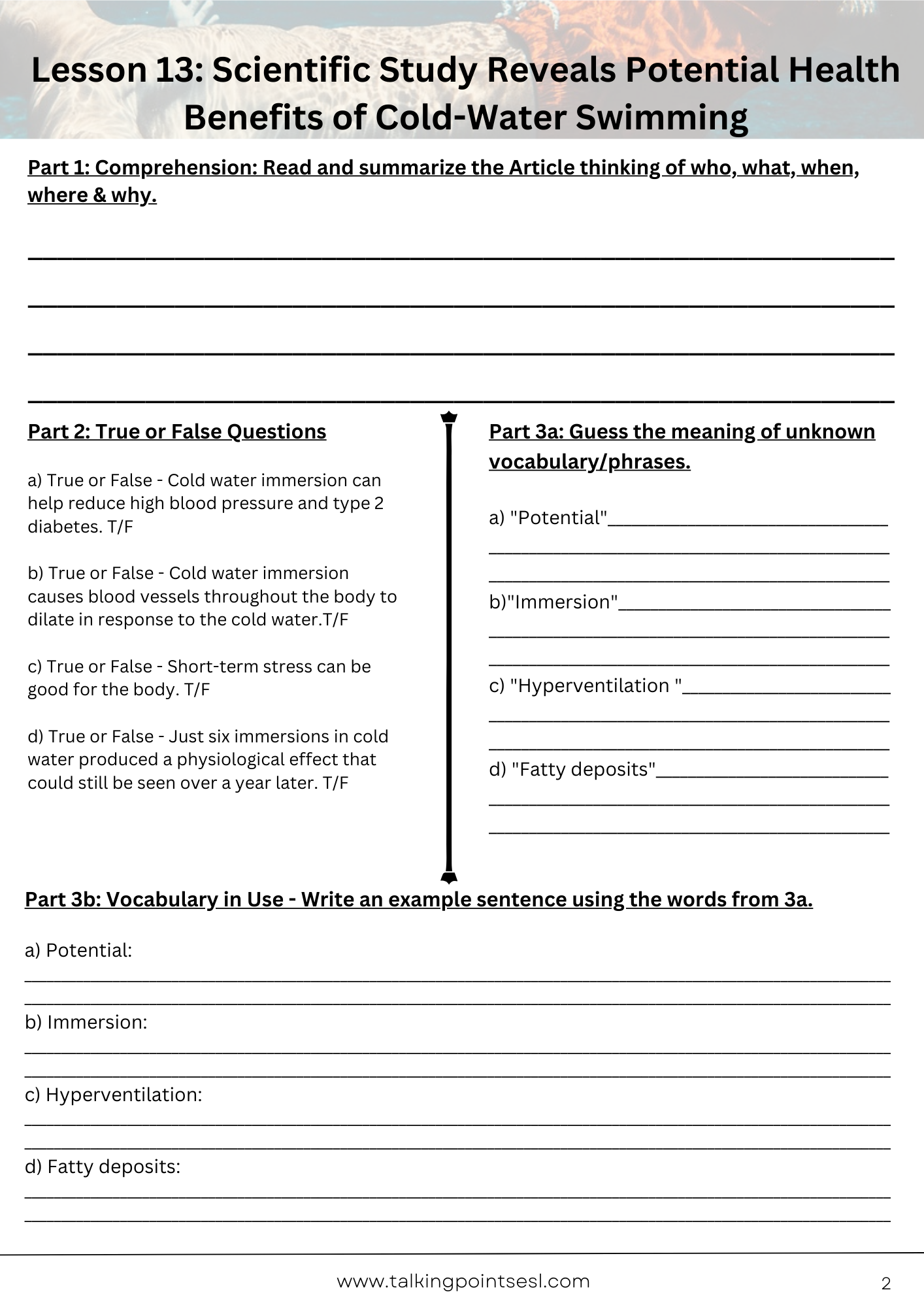
Scientific Study Reveals Potential Health Benefits of Cold-Water Swimming
Cold water swimming
Script:
Cold water swimming has gained popularity due to its potential to benefit both the body and mind, according to a recent scientific investigation. Researchers have been studying the physiological effects of cold water immersion and have discovered that it can offer an array of benefits, ranging from reducing high blood pressure and type 2 diabetes, to depression and chronic inflammation.
The human body has developed a stress response that automatically kicks in when under threat to keep the body alive. Cold water immersion activates this primal response, causing hyperventilation and an increase in heart rate. Blood vessels throughout the body react, quickly changing size in response to the cold water, putting the body into a state of survival.
However, studies have shown that a short burst of stress can be beneficial. Cold water is one of the most effective ways to create short-term stress across the body, leading scientists to investigate the potential benefits. Research is currently underway to determine how cold water can affect the immune system, stress hormones, and fatty deposits that clog arteries.
Studies have shown that winter swimmers are more resistant to certain illnesses and infections, experiencing them less frequently and more mildly. A 30-second cold shower every morning for 60 days was found to decrease the number of sick days by 30%. Cold water immersion has also been shown to help reduce the use of antidepressants, and exciting research is looking at how it can decrease inflammatory responses over time, potentially helping with conditions from rheumatism to depression.
"see if it works for you"
It looks as though cold-water treatment could have powerful and long-lasting effects. One study found that just six immersions in cold water produced a physiological effect that could still be seen over a year later. Experts recommend trying a short blast of cold water in the shower to see if it works for you.
Questions:
Part 1: Comprehension
Read and summarize the article thinking of who, what, when, where & why.
Part 2: True or False Questions
a) True or False - Cold water immersion can help reduce high blood pressure and type 2 diabetes. T/F
b) True or False - Cold water immersion causes blood vessels throughout the body to dilate in response to the cold water.T/F
c) True or False - Short-term stress can be good for the body. T/F
d) True or False - Just six immersions in cold water produced a physiological effect that could still be seen over a year later. T/F
Part 3a: Guess the meaning of unknown vocabulary/phrases.
a) "Potential"
b)"Immersion"
c) "Hyperventilation "
d) "Fatty deposits"
Part 3b: Vocabulary in Use: Write an example sentence using the words from 3a.
a) Potential:
b) Immersion:
c) Hyperventilation:
d) Fatty deposits:
Part 5: Talking Points
Part 6: Role play Scenarios
1: Doctor-Patient
A doctor and a patient are discussing the patient's health. The doctor recommends cold water swimming as a way to help with the patient's high blood pressure and type 2 diabetes. The patient is hesitant about trying it, and the doctor explains the potential benefits and offers advice on how to get started.
2: Fitness Instructor-Student
A fitness instructor is leading a class on cold water swimming. The instructor explains the physiological effects of cold-water immersion and the potential benefits it can offer. The students ask questions and share their own experiences with cold water swimming.
3: Friends Discussing Health
Two friends are discussing their health and wellness routines. One friend mentions that they have been taking cold showers every morning to boost their immune system and decrease their use of antidepressants. The other friend is interested in learning more about cold water immersion and how it could help with their own health issues.
Part 7: Writing Activity
Present Simple - What do you do to maintain a healthy lifestyle?
Part 8: Critical Thinking: Diet and Fitness
In pairs create a presentation outlining a week long diet and training schedule, think of:
1. Breakfast, lunch & dinner
2. Time available: work/family/hobbies
3. Levels of intensity of training with reasons
4. Types of training and location
Then present your schedules to the class. Finally, as a class put together a schedule that everyone can follow.
Answers:
Part 1: Comprehension
The main idea of this article is that cold water swimming has gained popularity due to its potential to benefit the body and mind. Researchers have been studying the physiological effects of cold-water immersion and have found an array of benefits ranging from reducing high blood pressure, type 2 diabetes, depression, chronic inflammation, and more. The article explains how cold-water immersion activates the body's stress response, which is important for short-term benefits. The article also highlights the ongoing research into how cold water can affect the immune system, stress hormones, and fatty deposits that clog arteries. The article was written to inform readers of the potential benefits of cold-water swimming and to provide insights into the ongoing scientific research in this area.
Part 2: True or False
A: True B: False C: True D: True
Part 3a: Guess the meaning of unknown vocabulary or phrases.
a) "Potential" Answer: This means possible or capable of happening, but not certain. In the context of the article, "potential" is used to describe the various health benefits that may be gained from cold water swimming.
b) "Immersion" Answer: This means the state of being completely submerged in a liquid. In the context of the article, "cold water immersion" refers to the act of completely submerging oneself in cold water.
c) "Hyperventilation " Answer: This means a condition in which someone breathes very quickly and deeply, which can result in dizziness, tingling in the fingers, and other symptoms. In the context of the article, "cold water immersion activates this primal response, causing hyperventilation" means that when someone first gets into cold water, they may start to breathe quickly and deeply as a result of the shock of the cold water.
d) "Fatty deposits" Answer: This means a build-up of fat in the walls of arteries, which can restrict blood flow and increase the risk of heart disease. In the context of the article, they talk about research that could reduce these blockages in arteries meaning that fatty deposits is fat that builds up and blocks arteries.
Part 3b: Vocabulary in Use: Write an example sentence using the words from 3a. (examples)
a) Potential: With her dedication and hard work, she has the potential to become a successful artist in the future.
b) Immersion: Spending a summer abroad in a Spanish-speaking country allowed him to experience full immersion in the language and culture.
c) Hyperventilation: After the intense workout, I experienced hyperventilation, which made me breathe quickly and feel dizzy.
d) Fatty deposits: The doctor explained that eating a balanced diet and exercising regularly can help prevent the buildup of fatty deposits in the arteries, which can lead to heart problems.
Part 7: Writing (example)
Maintaining a healthy lifestyle is essential to feeling my best every day. I make sure to prioritize regular exercise, aiming for a mix of cardio and strength training at least three times a week. Alongside that, I focus on a balanced diet rich in fruits, vegetables, lean proteins, and whole grains. Portion control is key for me, so I use smaller plates to avoid overeating. To manage stress, I practice mindfulness through meditation and deep breathing exercises. Quality sleep is non-negotiable, so I stick to a consistent sleep schedule and create a calming bedtime routine. Lastly, staying hydrated and minimizing processed foods are crucial components of my healthy lifestyle.