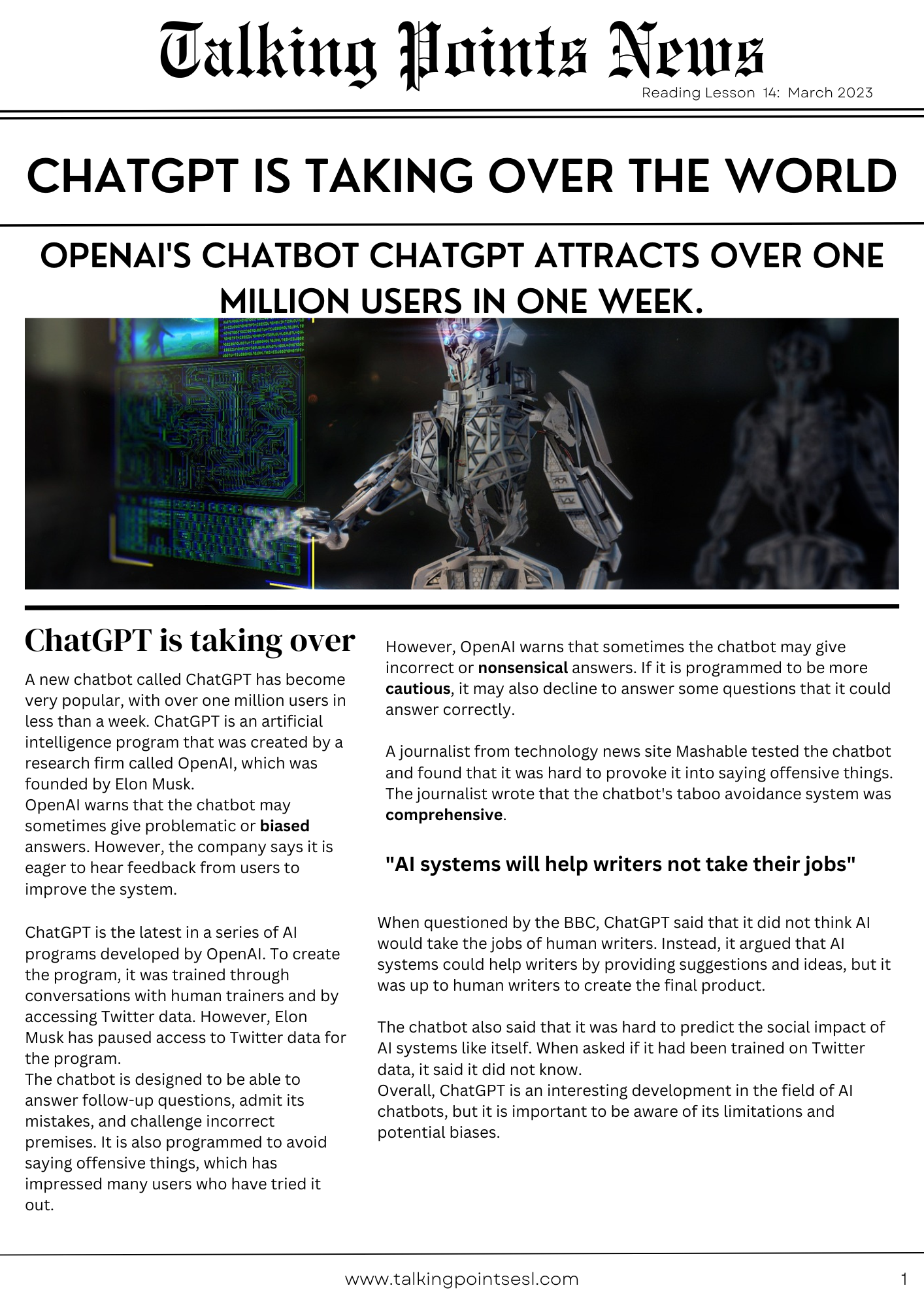
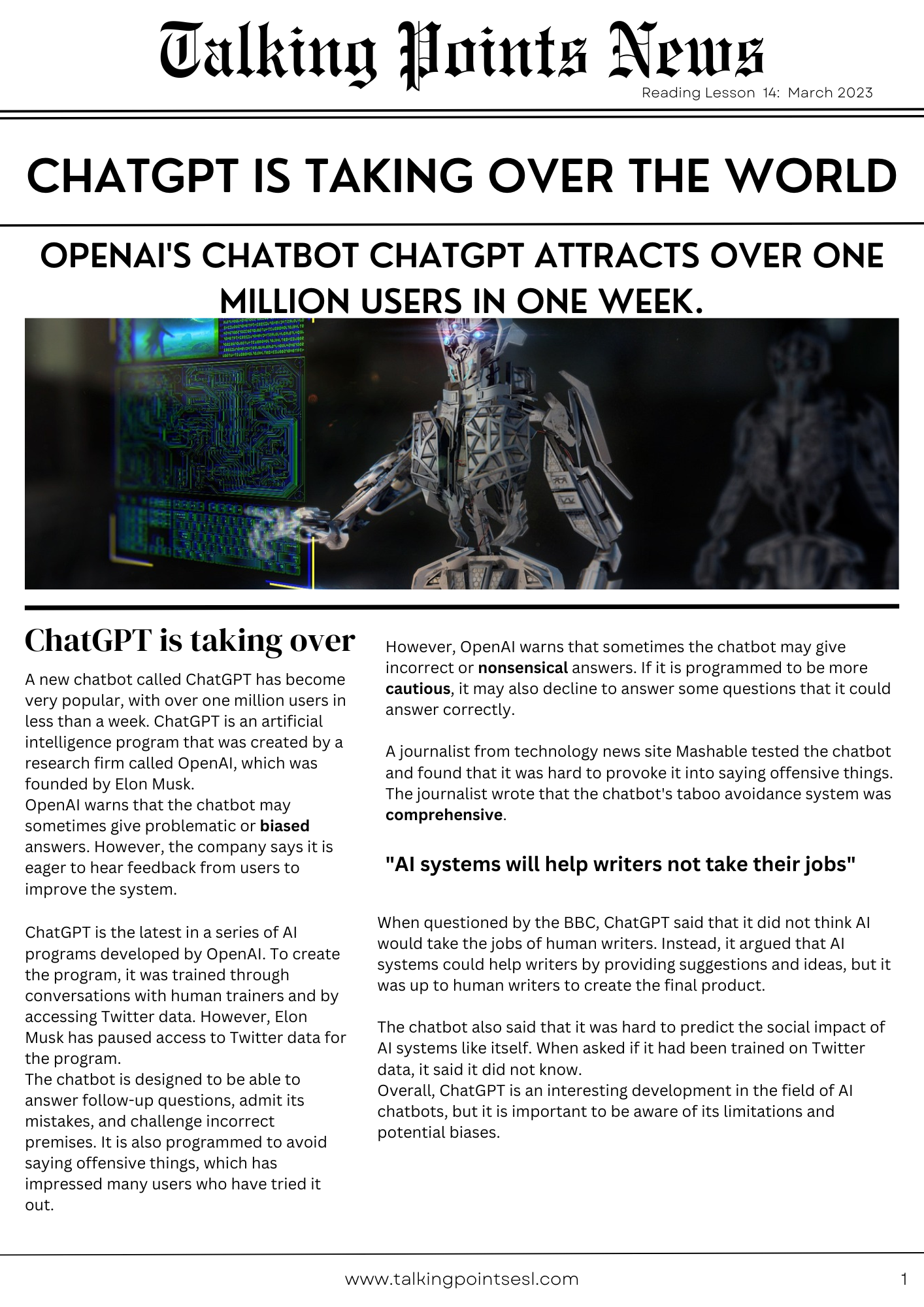
OpenAI's Chatbot ChatGPT Attracts Over One Million Users in One Week.
ChatGPT is taking over.
Script:
A new chatbot called ChatGPT has become very popular, with over one million users in less than a week. ChatGPT is an artificial intelligence program that was created by a research firm called OpenAI, which was founded by Elon Musk.OpenAI warns that the chatbot may sometimes give problematic or biased answers. However, the company says it is eager to hear feedback from users to improve the system.
ChatGPT is the latest in a series of AI programs developed by OpenAI. To create the program, it was trained through conversations with human trainers and by accessing Twitter data. However, Elon Musk has paused access to Twitter data for the program.The chatbot is designed to be able to answer follow-up questions, admit its mistakes, and challenge incorrect premises. It is also programmed to avoid saying offensive things, which has impressed many users who have tried it out.
However, OpenAI warns that sometimes the chatbot may give incorrect or nonsensical answers. If it is programmed to be more cautious, it may also decline to answer some questions that it could answer correctly.A journalist from technology news site Mashable tested the chatbot and found that it was hard to provoke it into saying offensive things. The journalist wrote that the chatbot's taboo avoidance system was comprehensive.
"AI systems will help writers not take their jobs"
When questioned by the BBC, ChatGPT said that it did not think AI would take the jobs of human writers. Instead, it argued that AI systems could help writers by providing suggestions and ideas, but it was up to human writers to create the final product.The chatbot also said that it was hard to predict the social impact of AI systems like itself. When asked if it had been trained on Twitter data, it said it did not know.Overall, ChatGPT is an interesting development in the field of AI chatbots, but it is important to be aware of its limitations and potential biases.
Questions:
Part 1: Comprehension
Read and summarize the article thinking of who, what, when, where & why.
Part 2: True or False Questions
a) True or False - ChatGPT has gained over one million users in less than a week. Answer.T/F
b) True or False - OpenAI warns that the chatbot may sometimes give problematic or biased answers. T/F
c) True or False - Elon Musk has not paused access to Twitter data for the program. T/F
d) True or False - ChatGPT is programmed to avoid saying offensive things, and its taboo avoidance system is comprehensive. T/F
Part 3a: Guess the meaning of unknown vocabulary/phrases.
a) "Biased"
b)"Nonsensical"
c) "Cautious"
d) "Comprehensive”
Part 3b: Vocabulary in Use: Write an example sentence using the words from 3a.
a) Biased:
b) Nonsensical:
c) Cautious:
d) Comprehensive:
Part 5: Talking Points
Part 6: Role play Scenarios
1: Chatbot job interview
In this role play, students take on the role of job candidates who are interviewing for a position at a company that uses ChatGPT as part of its customer service. The interviewer can ask the students to interact with the chatbot to see how they would handle various customer service scenarios and how they would use the chatbot to help resolve customer issues.
2: Chatbot ethics debate
In this role play, students take on the role of a panel of experts who are debating the ethics of using AI chatbots like ChatGPT. The students can explore the potential benefits and risks of AI chatbots, and discuss issues such as bias, privacy, and job displacement. They can also propose potential solutions to mitigate the risks and maximize the benefits of this technology.
3: Interview with ChatGPT developer
In this role play, students take on the role of reporters and interview a developer from OpenAI who is responsible for creating ChatGPT. The students can ask questions about the design of the chatbot, its capabilities and limitations, as well as its potential impact on society.
Part 7: Writing Activity
Future Tense - In what ways do you think ChatGPT or AI will make your life easier in the future?
Part 8: Critical Thinking: ChatGPT & Learning
"AI robots and chatbots will replace teachers and educators in the future".
In pairs discuss the statement above, giving reasons and examples to support your answers. Then as a class debate whether you think the statement will become a reality or not.
Answers:
Part 1: Comprehension
The main idea of the article is that OpenAI's chatbot called ChatGPT has quickly gained one million users in one week since it was publicly released. The article discusses the development process of the chatbot, including how it was fine-tuned through conversations with human trainers and learned from Twitter data. The article also highlights that the chatbot can produce problematic answers and exhibit biased behavior. However, the chatbot's ability to answer follow-up questions and avoid offensive language has impressed many users. The article was likely written to inform readers about the development and potential benefits and drawbacks of OpenAI's new chatbot.
Part 2: True or False
A: True B: True C: False D: True
Part 3a: Guess the meaning of unknown vocabulary or phrases.
a) "Biased" Answer: This is a tendency to show favor or opposition to something or someone without a good reason. In the context of the article, OpenAI warns that the chatbot may sometimes give problematic or biased answers, meaning it may show an unfair preference or opposition towards certain things or ideas.
b) "Nonsensical" Answer: I think this means not making sense or having no meaning. The article warns that ChatGPT may sometimes write nonsensical answers, meaning it may give responses that are not logical or coherent.
c) "Cautious" Answer: This means careful and hesitant in making decisions or taking action. The article notes that if ChatGPT is programmed to be more cautious, it may decline to answer some questions that it could answer correctly, meaning it would be more hesitant in providing a response.
d) "Comprehensive" Answer: In the article, the word "comprehensive" is used to describe the chatbot's "taboo avoidance system". The journalist who tested the chatbot wrote that the system was "pretty comprehensive". In this context, "comprehensive" means that the system was thorough or complete in avoiding offensive or inappropriate language.
Part 3b: Vocabulary in Use: Write an example sentence using the words from 3a. (examples)
a) Biased: The news article seemed biased, as it only presented one side of the story.
b) Nonsensical: The instructions for assembling the furniture were so nonsensical that I had to ask for help to figure out how to put it together.
c) Cautious: She took a cautious approach while exploring the unfamiliar hiking trail, making sure to watch her step and stay safe.
d) Comprehensive: The new textbook provides a comprehensive overview of world history.
Part 7 Writing (example)
I believe that ChatGPT and AI will help me in many ways in the future. They can give me quick answers and help me find information without searching for a long time. Also, they might suggest things I like, like what to buy or activities to do. AI could help me understand different languages, so I can talk to people from other countries. It might also do tasks for me, like scheduling and organizing things, so I have more time for important stuff. I think AI will be like a smart friend that helps me with many things and makes life simpler.