WHO Report World falling behind on reducing sodium intake.
High Sodium Intake.
Script:
The World Health Organization (WHO) has released a report stating that the world is falling behind in achieving its goal of reducing sodium intake by 30% by 2025. This goal was set by all 194 WHO member countries in 2013, but only 5% of these countries have implemented comprehensive sodium-reduction policies, as stated in the report released on Thursday.Dr. Francesco Branca, director of WHO’s Department of Nutrition for Health and Development, has expressed his concern over the slow progress made by countries in reducing population sodium intake. He suggests that the target may have to be extended to 2030.Consuming too much sodium increases a person's risk of heart disease, stroke, and premature death. The Institute for Health Metrics and Evaluation has reported that this accounts for nearly 2 million deaths worldwide each year. The report estimates that the global average salt intake is 10.8 grams per day, which is more than double the WHO's recommendation of less than 5 grams per day in adults.
The report evaluated country implementation of sodium-reduction policies using a “Sodium Country Score Card,” with scores ranging from 1 (the lowest level of implementation) to 4 (the highest level). Only nine countries had a score of 4, meaning they had comprehensive sodium-reduction policies, according to WHO. These countries are Brazil, Chile, Czech Republic, Lithuania, Malaysia, Mexico, Saudi Arabia, Spain, and Uruguay. The United States scored 3 out of 4 for having at least one mandatory sodium policy and a declaration of sodium on pre-packaged food.Dr. Tom Frieden, president and CEO of Resolve to Save Lives, a not-for-profit organization working with countries to prevent 100 million deaths from cardiovascular disease over 30 years, has urged countries to work urgently to implement ambitious, mandatory, government-led sodium reduction policies to meet the global target of reducing salt consumption by 2025. Dr. Laura Cobb, director of nutrition policy and surveillance at Resolve to Save Lives, has stated that the US has led successful efforts in reducing sodium in mandatory school meal guidelines, but more work needs to be done on national policies and food labeling and marketing.
"reformulating processed foods"
WHO has called on countries to implement interventions related to sodium, including reformulating processed foods to contain less salt, establishing policies to limit sodium-rich foods in public institutions, and including front-of-package labeling that helps consumers select products lower in sodium. Such policies could save an estimated 7 million lives globally by 2030 and reduce sodium intake by over 20%, WHO says, getting close to the target set for 2025.The report emphasizes that it is time for countries to take action, and it hopes to be a call to action to prevent heart disease before it starts.
Questions:
Part 1: Comprehension
Read and summarize the article thinking of who, what, when, where & why.
Part 2: True or False Questions
a) True or False - The World Health Organization wants to reduce sodium intake by 40% by 2025. T/F
b) True or False - Dr. Francesco Branca isn’t very concerned about the issue. T/F
c) True or False - Globally salt intake is more than twice the WHOs recommendation . T/F
d) True or False - The United States scored a 4 out of 4 on the Sodium Country scorecard. T/F
Part 3a: Guess the meaning of unknown vocabulary/phrases.
a) "Falling behind"
b) "Premature"
c) "Mandatory"
d) "Interventions"
Part 3b: Vocabulary in Use - Write an example sentence using the words from 3a.
a) Falling behind:
b) Premature:
c) Mandatory:
d) Interventions:
Part 5: Talking Points
Part 6: Role play Scenarios
A doctor is advising a patient on their diet and discussing the risks of consuming too much sodium. The patient is resistant to making any changes to their diet and argues that they don't have time to prepare healthy meals.
A government official is meeting with a representative from the food industry to discuss ways to reduce sodium intake in processed foods. The industry representative is concerned about the cost of reformulating their products and argues that consumers won't like the taste of lower-sodium options.
An activist is meeting with a community leader to discuss ways to raise awareness about the risks of consuming too much sodium. The community leader is skeptical of the need for action and argues that people should be free to eat whatever they want. The activist tries to convince them of the importance of public health initiatives and the benefits of reducing sodium intake.
Part 7: Writing Activity
Present tense - Describe your diet in a much detail as possible. What do you like to eat for breakfast, lunch dinner? Is it healthy?
Part 8: Critical Thinking - Effective labeling?
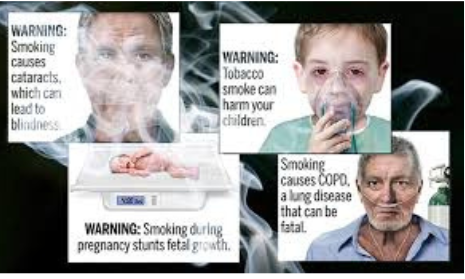
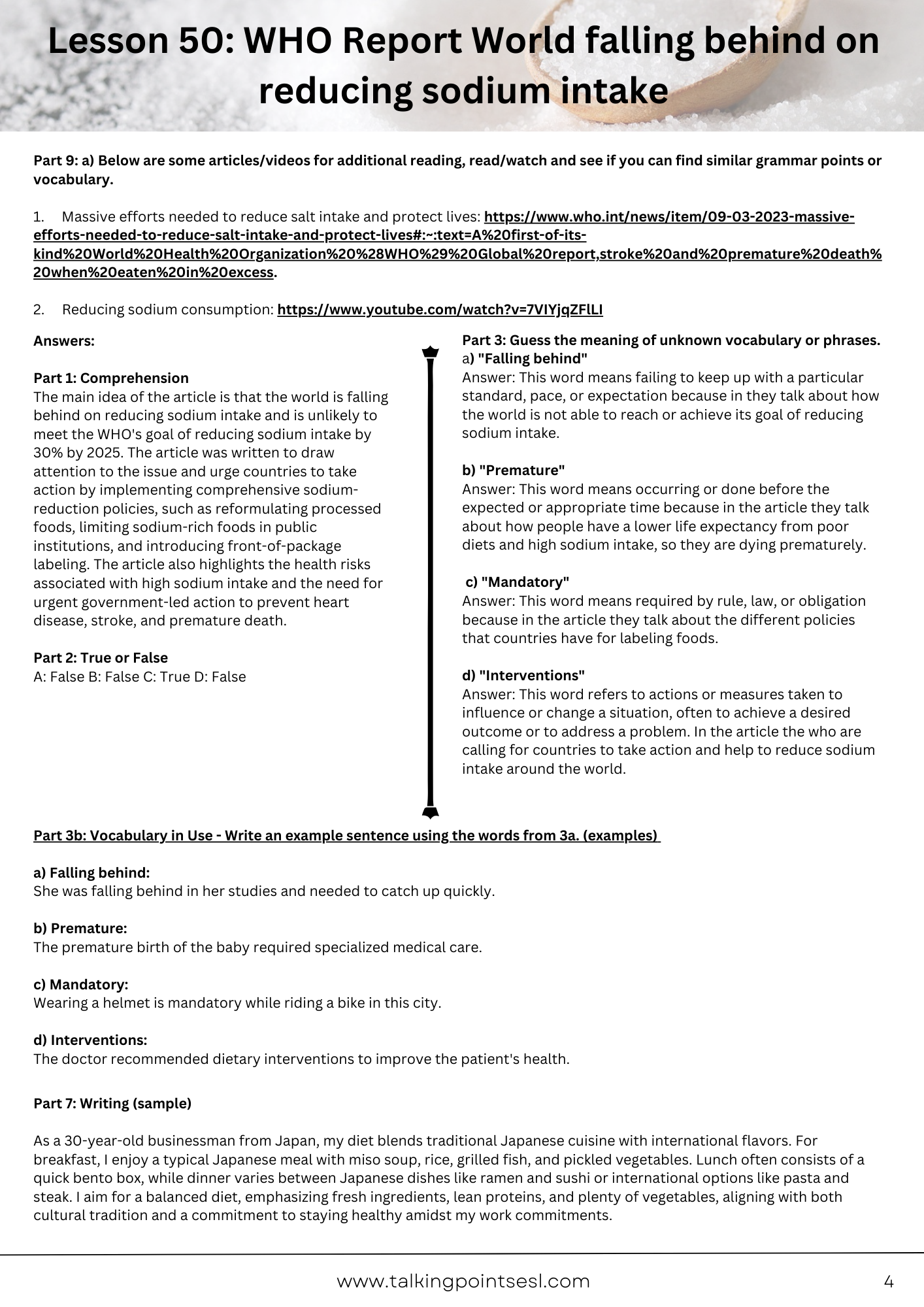
This is how cigarettes are labeled in some countries. Do you think that food should be labeled like this in regards to both sugar and salt?
Work in groups and discuss this question, then come together and reach a consensus on the best way to tackle the problem of too much salt and sugar in our diets.
Answers:
Part 1: Comprehension
The main idea of the article is that the world is falling behind on reducing sodium intake and is unlikely to meet the WHO's goal of reducing sodium intake by 30% by 2025. The article was written to draw attention to the issue and urge countries to take action by implementing comprehensive sodium-reduction policies, such as reformulating processed foods, limiting sodium-rich foods in public institutions, and introducing front-of-package labeling. The article also highlights the health risks associated with high sodium intake and the need for urgent government-led action to prevent heart disease, stroke, and premature death.
Part 2: True or False
A: False B: False C: True D: False
Part 3: Guess the meaning of unknown vocabulary or phrases.
a) "Falling behind" Answer: This word means failing to keep up with a particular standard, pace, or expectation because in they talk about how the world is not able to reach or achieve its goal of reducing sodium intake.
b) "Premature" Answer: This word means occurring or done before the expected or appropriate time because in the article they talk about how people have a lower life expectancy from poor diets and high sodium intake, so they are dying prematurely.
c) "Mandatory" Answer: This word means required by rule, law, or obligation because in the article they talk about the different policies that countries have for labeling foods.
d) "Interventions" Answer: This word refers to actions or measures taken to influence or change a situation, often to achieve a desired outcome or to address a problem. In the article the who are calling for countries to take action and help to reduce sodium intake around the world.
Part 3b: Vocabulary in Use - Write an example sentence using the words from 3a. (examples)
a) Falling behind: She was falling behind in her studies and needed to catch up quickly.
b) Premature: The premature birth of the baby required specialized medical care.
c) Mandatory: Wearing a helmet is mandatory while riding a bike in this city.
d) Interventions:The doctor recommended dietary interventions to improve the patient's health.
Part 7: Writing (sample)
As a 30-year-old businessman from Japan, my diet blends traditional Japanese cuisine with international flavors. For breakfast, I enjoy a typical Japanese meal with miso soup, rice, grilled fish, and pickled vegetables. Lunch often consists of a quick bento box, while dinner varies between Japanese dishes like ramen and sushi or international options like pasta and steak. I aim for a balanced diet, emphasizing fresh ingredients, lean proteins, and plenty of vegetables, aligning with both cultural tradition and a commitment to staying healthy amidst my work commitments.